
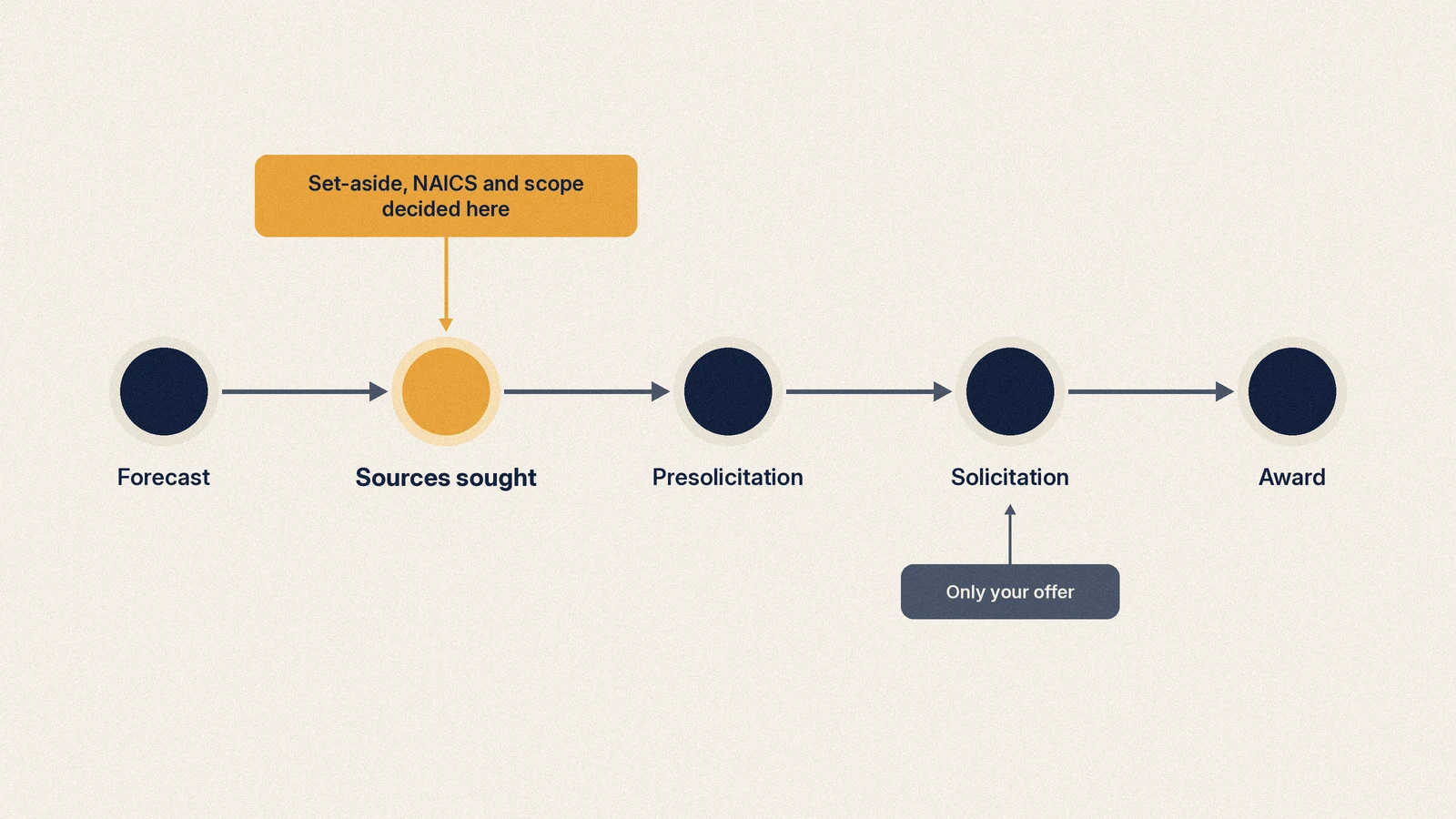
A sources sought notice is a federal agency's market research, posted on SAM.gov before a solicitation exists, asking capable firms to say who they are, what they can do and whether they are small. It is not a bid request and nothing is awarded from it. But your response is one of the main inputs the contracting officer uses to decide whether the eventual contract is set aside for small business, which makes it the cheapest leverage in federal contracting.
What is a sources sought notice?
A sources sought notice (SSN, sometimes called a sources sought synopsis) is a public request for information about potential sources. The agency has a requirement in mind, often with a draft performance work statement (PWS) or statement of work attached, and wants to know who can do it before deciding how to buy it.
On SAM.gov, "Sources Sought" is its own notice type in Contract Opportunities, next to Presolicitation, Solicitation, Combined Synopsis/Solicitation and Special Notice. The FAR itself names it only once: FAR 5.205(a) lets contracting officers post "Research and Development Sources Sought" advance notices when market research has not turned up enough firms, and says contracting officers must consider the firms that respond for the later solicitation. Every other sources sought you see is a market research technique under Part 10.
A typical notice contains:
- A title and notice ID, often prefixed with the product or service code (for example "J041" or "Z2DA")
- A short description of the requirement, plus a draft PWS, SOW or specification
- The anticipated NAICS code and size standard
- The place of performance and, sometimes, an estimated value or period of performance
- A list of questions, usually about size, socioeconomic status, capability and past performance
- A response date, an email address and often a page limit
- Disclaimer language saying the notice is not a solicitation and the government will not pay for responses
That disclaimer scares some vendors off. It should not. It is standard wording, and it is what every RFI must say under the FAR Overhaul Part 15 text.
Why sources sought is the least-competed step
Solicitations get the attention because that is where awards happen. As of 2026-10-07, RFPFinder tracks 8,018 open solicitations, combined synopses and presolicitations across federal, state and local buyers, and only 698 open sources sought and RFI notices.
| Notice stage | Open notices RFPFinder tracks (as of 2026-10-07) | What you can influence |
|---|---|---|
| Sources sought and RFI | 698 | Set-aside decision, NAICS code, scope, contract type |
| Presolicitation | 963 | Your preparation time; little else |
| Combined synopsis/solicitation | 3,062 | Only your offer |
| Solicitation | 3,993 | Only your offer, plus formal questions |
Fewer notices means fewer competitors reading them, and the stakes are lopsided. At the solicitation stage you are one of many offers. At the sources sought stage you may be one of a handful of firms the contracting officer hears from, and what you send helps decide who is even allowed to compete.
There is also a quieter benefit. Your response goes into the market research file the agency must document under FAR 10.001(e), and the contracting officer and program staff read it before the requirement is final. When the RFP posts, your firm is a known name rather than a stranger.
FAR Part 10: the market research behind every notice
Sources sought notices exist because the FAR requires market research. Under the codified FAR 10.001 (FAC 2026-01, effective 13 March 2026), agencies must conduct market research before developing new requirements documents, before soliciting offers above the simplified acquisition threshold, and before certain task and delivery orders. The results feed decisions on whether capable sources exist, whether commercial products or services fit, whether a requirement is being consolidated or bundled, and whether small business programs apply.
FAR 10.002 lists the techniques: contacting knowledgeable people in government and industry, reviewing earlier market research, publishing formal requests for information, querying SAM and FPDS, holding presolicitation conferences, and more. A sources sought on SAM.gov is the most visible of these, and the one any firm can answer.
What changed with the FAR Overhaul
In 2025 the FAR Council began the Revolutionary FAR Overhaul (RFO), and agencies have been adopting rewritten parts through class deviations. The RFO Part 10 keeps the core duty, market research before new requirements documents and before acquisitions or orders over the simplified acquisition threshold, and adds two lines vendors should know:
- Agencies "should engage in responsible and constructive exchanges with industry" (10.001(c)).
- Agencies "must not ask potential sources to submit more than the minimum information necessary" (10.001(d)).
The second line matters for length. A short, specific response is exactly what the rules now ask agencies to request. Which version governs a given notice depends on whether that agency has adopted the deviation, and the RFO deviation guide lists agencies part by part. In practice the response you write is the same either way.
The thresholds that frame all of this are in FAR 2.101: the micro-purchase threshold is $15,000 and the simplified acquisition threshold is $350,000, with exceptions for construction, services and contingency buys.
The Rule of Two: how responses decide set-asides
The Rule of Two is the reason sources sought responses carry so much weight.
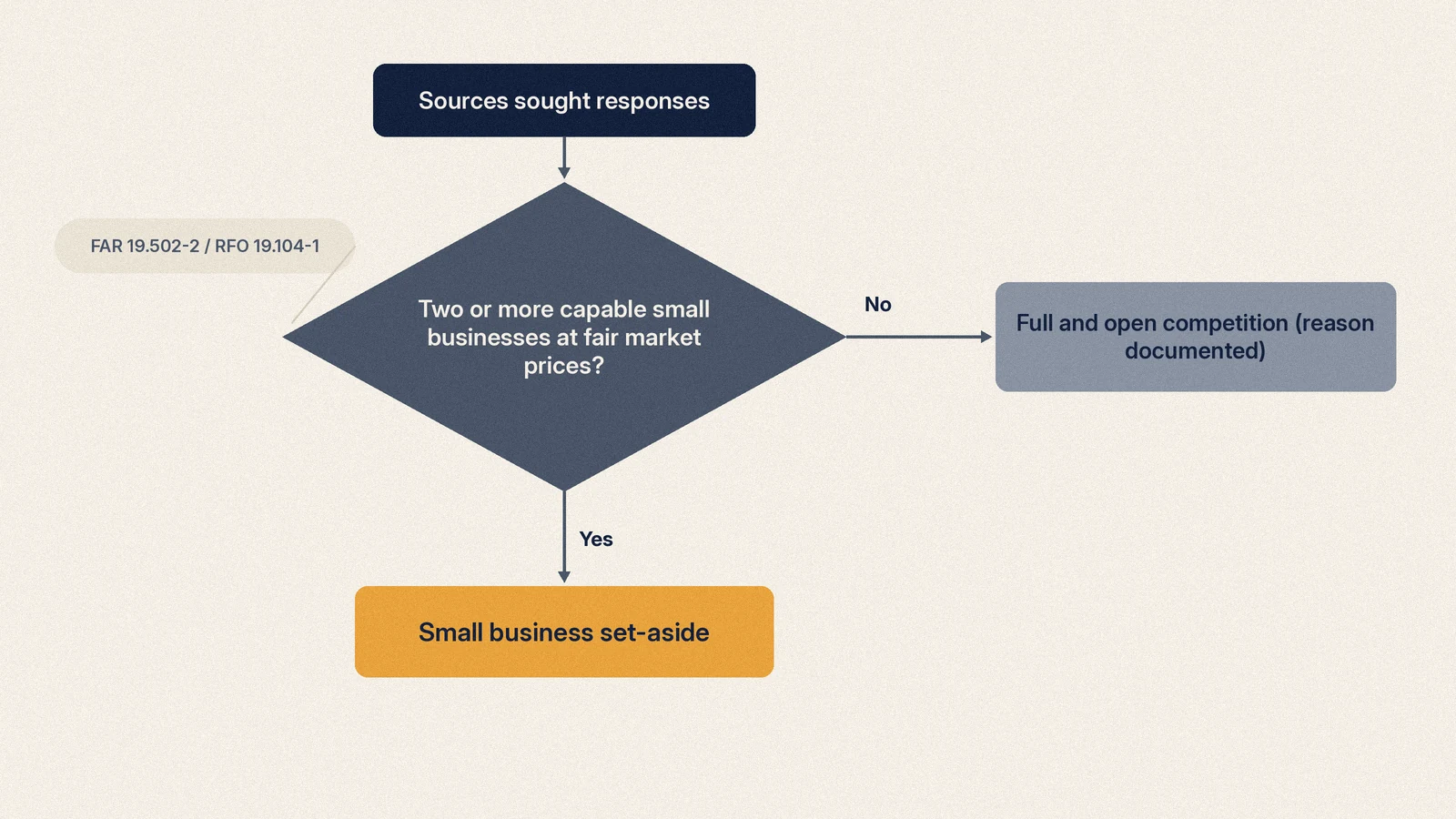
In the codified FAR, 19.502-2(b) says the contracting officer shall set aside any acquisition over the simplified acquisition threshold for small business when there is a reasonable expectation that offers will come from at least two responsible small business concerns and award will be made at fair market prices. For acquisitions above the micro-purchase threshold but not over the simplified acquisition threshold, 19.502-2(a) flips the presumption: they shall be set aside unless the contracting officer finds no reasonable expectation of two competitive small business offers.
The RFO Part 19 folds both into 19.104-1: for contracts above the micro-purchase threshold, the contracting officer must set the contract aside if there is a reasonable expectation of offers from two or more responsible small businesses that are competitive on fair market prices, quality and delivery, and must document the reason when a contract is not set aside. The same two-firm logic appears in the RFO rules for HUBZone, SDVOSB and EDWOSB and WOSB set-asides (19.105-2, 19.106-2 and 19.107-2).
Where does a "reasonable expectation" come from? Past buying history, SBA input, SAM searches and, very often, sources sought responses. If two or more capable small businesses answer credibly, the contracting officer has a documented basis to set the work aside. If none answer, the file supports going full and open, and you will compete against firms many times your size.
What set-asides look like in live federal notices
As of 2026-10-07, 2,317 of the 5,731 open federal notices RFPFinder tracks (40.4%) carry at least one set-aside. Live, the share reads 49% (2,899 of 5,876).
| Set-aside on open federal notices | Notices | Share of 5,731 open federal notices |
|---|---|---|
| Total small business | 1,844 | 32.2% |
| SDVOSB | 251 | 4.4% |
| WOSB | 126 | 2.2% |
| HUBZone | 81 | 1.4% |
| 8(a) | 20 | 0.3% |
| VOSB | 6 | 0.1% |
| EDWOSB | 5 | 0.1% |
| Any set-aside | 2,317 | 40.4% |
Source: RFPFinder snapshot of SAM.gov notices, 2026-10-07. A notice can carry more than one code, so rows sum to more than the total.
The remaining 59.6% are unrestricted. Some of those are commodity buys where no small business answered the market research. That is the gap a good response closes. For how each certification works, see our guide to government contracts for small business.
Sources sought vs RFI vs presolicitation
Agencies use these labels loosely, and the questions inside the notice tell you more than the title. Here is how they usually differ.
| Sources sought | RFI (request for information) | Presolicitation | Solicitation (RFP, RFQ, IFB) | |
|---|---|---|---|---|
| Main question | Who can do this, and are they small? | How should we buy this? | Heads up, a solicitation is coming | Send your offer |
| FAR basis | Part 10 market research; 5.205(a) for R&D | FAR 15.201(e); RFO 15.101(c) | Part 5 synopsis | Parts 12, 13, 14, 15 |
| What you send | Capability, size, status, past performance, answers | Answers on approach, pricing models, draft requirement | Usually nothing; prepare | A compliant offer with price |
| Binding? | No | No; responses are not offers | No | Yes, an offer can be accepted |
| What you can change | Set-aside, NAICS, scope | Strategy, terms, requirement wording | Little | Only your own odds |
Under FAR 15.201(e), RFIs may be used when the government does not presently intend to award a contract but wants price, delivery, market or capability information for planning, and "there is no required format for RFIs." The RFO version adds that every RFI must state that no contract will be awarded from it and that responses are information only.
At state and local level, a government RFI is the nearest equivalent; most state portals have no separate sources sought type. For the full set of notice types, see RFP vs RFQ vs RFI.
What a strong sources sought response contains
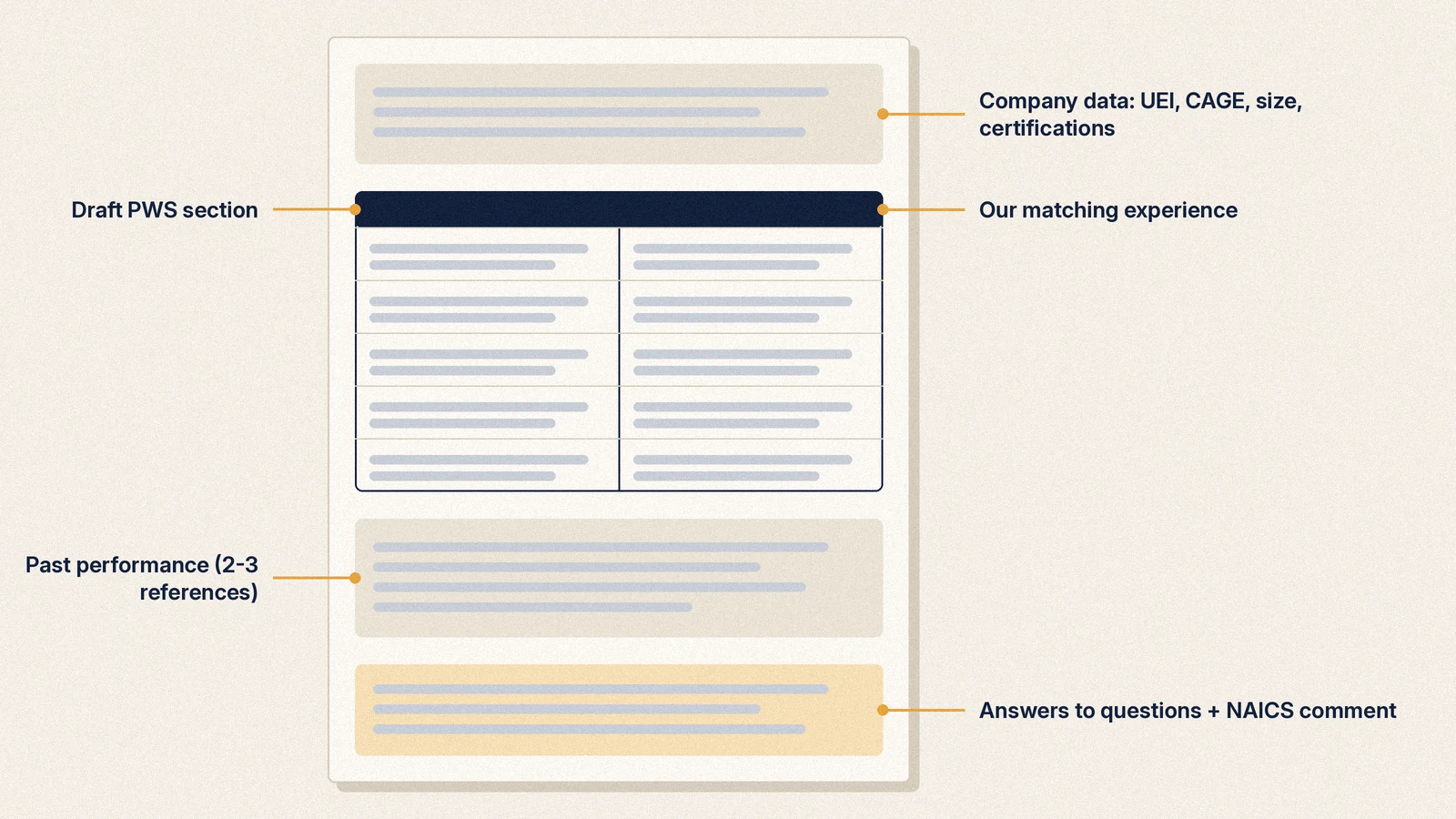
Think of the response as evidence for a file, not a brochure. The contracting officer is trying to answer narrow questions: can this firm do the work, is it small under this NAICS code, and does it hold the status a set-aside would need? Make each answer easy to find.
1. A company data block at the top
Put the identifying facts in one place so nobody has to hunt for them:
- Legal name exactly as registered in SAM, UEI and CAGE code
- Point of contact with phone and email
- Business size under the notice's NAICS code and size standard
- Socioeconomic status: small business, 8(a), HUBZone, SDVOSB, VOSB, WOSB or EDWOSB, with certification status
- Relevant contract vehicles (GSA Multiple Award Schedule, GWACs, agency IDIQs)
- Whether you intend to bid as prime, as a joint venture or as a subcontractor
2. A capability narrative mapped to the draft PWS
This is the core, and where most responses are weak. Take the draft PWS or SOW section by section and say, for each one, how you have done that work. A two-column table works well: the PWS paragraph on the left, your matching experience on the right. Use the agency's wording. A generic capability statement does not prove you can do this specific requirement.
If you cannot self-perform part of the scope, say how you would cover it: a named teaming partner, a subcontractor, or a joint venture. That still counts toward small business capacity.
3. Past performance that looks like this job
Two or three references are enough. For each give the customer, contract number, value, period of performance and a two-line scope summary showing similar size, complexity and type of work. Commercial and state or local work counts, and federal references are easy to check on USAspending.
4. Your view on the NAICS code and size standard
If the anticipated NAICS code looks wrong, say so now and propose the code that better fits the principal purpose of the work, with the size standard from the SBA table of size standards. Once the solicitation is out, under the RFO Part 19 text a NAICS code appeal to SBA's Office of Hearings and Appeals must be filed within 10 calendar days of the solicitation or the amendment that set the code. A sentence in the sources sought response costs far less.
5. Comments on the acquisition strategy
This is the part nobody else writes. If the scope bundles trades that no small firm self-performs, if the bonding or experience thresholds look higher than the work needs, or if the period of performance or contract type creates risk, say so briefly and offer an alternative. Contracting officers are told to welcome these early exchanges: FAR 15.201(c) lists contract type, statements of work and evaluation criteria among the concerns early exchanges can resolve.
6. A direct answer to every question
Number your answers to match the notice. If the notice asks "Do you have a facility clearance?", the first word of your answer is yes or no. Skipping a question, especially the small business questions, is the fastest way to be left out of the count.
Sources sought response template and format
No FAR rule sets a format, so the notice's own instructions come first. When it gives none, this outline fits in three to five pages:
- Cover header: notice ID, title, agency, response date, your company name and contact.
- Company data block: UEI, CAGE, size under the stated NAICS, certifications, vehicles, prime or sub intent.
- Capability matrix: draft PWS sections in one column, your matching experience in the other.
- Past performance: two or three references with contract numbers, values and dates.
- Answers to the notice's questions, numbered to match.
- NAICS and acquisition strategy comments: two to five sentences.
- Optional: your one-page capability statement as an attachment, never as the whole response.
| Format question | What to do |
|---|---|
| Page limit stated | Stay under it. Extra pages may not be read. |
| No page limit | Three to five pages is usually enough. |
| File type | PDF unless the notice says otherwise. Name the file with the notice ID and your company name. |
| Submission | Use the method named in the notice, usually email to the contracting officer or specialist. |
| Subject line | Notice ID, short title, company name. |
| Pricing | Only if asked. Label any figure as a non-binding estimate. |
| Proprietary data | Mark it. The FAR Overhaul Part 15 text tells agencies to safeguard RFI information from unauthorized disclosure. |
| Confirmation | Ask for a reply confirming receipt. |
A capability statement is a one-page marketing summary of your firm. It is a useful attachment but a poor response on its own, because it is not mapped to this requirement and usually does not answer the notice's questions.
How to respond in 48 hours
Response windows are short and vary by notice, so speed comes from preparation, not from writing faster.
- Keep a response kit. Hold your company data block, size and status table by NAICS code, five or six past performance write-ups and a current capability statement in one folder. Most of the response is assembly.
- Triage the same day. Read the draft PWS and the questions. If you could perform at least a meaningful share of the work as prime or sub, respond. If not, skip it.
- Build the capability matrix first. It forces you to read the whole PWS and shows your gaps early.
- Pick the references. Choose the two or three closest in scope and size, not the biggest.
- Write the strategy comments last. By then you know which assumptions in the draft are off.
- Check against the questions. Every question answered, size status stated under the right NAICS code, page limit met.
- Send, then log it. Record the notice ID, office and contact. When a solicitation appears from that office, you want to recognize it at once.
From sources sought to solicitation: the timeline
The FAR sets no interval between a sources sought and a solicitation, and some sources sought never lead to one. Budgets move, requirements change, or the agency buys through an existing vehicle instead. What we can show is how often the link appears in live data.
For every open federal notice, RFPFinder looks for an earlier sources sought from the same buyer, matched on solicitation number or on office plus a similar title. As of 2026-10-07, 209 open solicitations carry that "sources sought prior" signal, tracing back to 125 distinct sources sought notices. Here is how long before the snapshot date those earlier notices were posted:
| Linked sources sought posted | Open notices linked | Share of 209 |
|---|---|---|
| Within the last 30 days | 106 | 50.7% |
| 31 to 90 days earlier | 18 | 8.6% |
| 91 to 180 days earlier | 24 | 11.5% |
| 181 to 365 days earlier | 38 | 18.2% |
| More than a year earlier | 23 | 11.0% |
Source: RFPFinder competition signals, snapshot 2026-10-07. One Defense Logistics Agency parts-kit sources sought links to 42 open notices, which inflates the first row.
Two patterns stand out. Supply buys, often Defense Logistics Agency parts with a national stock number, move from sources sought to solicitation in weeks. Construction, facility support and ship repair often take six months to a year: a dredging sources sought from May 2026, a hangar construction notice from March 2026 and a facility support notice from January 2026 all have open follow-on solicitations in our data now.
Once the solicitation posts, the window is short. As of 2026-10-07, open federal notices in our data average 30.8 days open, against 43.7 days for state notices. Firms that answered the sources sought months earlier start that clock with the capability matrix and references already written.

Where sources sought fits with recompetes
Some sources sought notices are for work already under contract. When an incumbent contract nears its end, the office runs market research for the follow-on. If you track expiring contracts on USAspending, you can expect the sources sought and be ready before it posts. RFPFinder's recompete radar lists federal awards with period-of-performance end dates in the next 12 months for exactly this reason.
Common mistakes
- Treating it as a sales pitch. Adjectives do not move the Rule of Two count. Evidence mapped to the PWS does.
- Missing the small business questions. If you do not state your size under the notice's NAICS code and your certifications, the contracting officer cannot count you toward the two small businesses.
- Sending only a capability statement. It does not answer the questions and is not mapped to the requirement.
- Ignoring a wrong NAICS code. If the size standard is too low for you, or too high and lets large firms in, say so now rather than face a 10-day appeal window later.
- Overstating capability. The contracting officer may read your proposal later. Claims you cannot back up hurt you twice.
- Skipping notices because you cannot do all of it. Say which part you would perform and with whom. Partial capability still counts as information.
- Missing the response date. A late response may never be read, and the agency owes you no follow-up.
- Not watching for the follow-on. The solicitation may come months later under a different notice ID. Track the office, not just the notice.
- Including unrequested pricing. It can anchor the government's estimate before you know the full scope.
What RFPFinder shows you
RFPFinder puts the early stage and the solicitation stage in one place, with the context that links them.
- A sources sought feed. The Sources sought tab lists open sources sought and RFI notices from SAM.gov and state and local portals, 698 as of 2026-10-07, apart from the 9,682 open solicitations.
- A competition signal on every solicitation. Each open notice gets a label from USAspending award history and the notice text. As of 2026-10-07: 3,039 likely competitive, 1,846 incumbent-favoured, 43 sole-source and 2,565 unknown. Signals include the incumbent, repeat winners, short response windows, brand-name language and a prior sources sought from the same buyer.
- Early signal alerts. Pro alerts can include sources sought and forecasts alongside solicitations, filtered by NAICS, PSC, state and set-aside. See pricing.
- Recompetes before the sources sought. The recompete radar shows expiring federal contracts with incumbent, office, NAICS and PSC.
- Code pages. Browse open notices by NAICS code to see what an office buys under your codes, and check our coverage for which portals we monitor.
| Competition label (open notices, 2026-10-07) | Notices | Share |
|---|---|---|
| Likely competitive | 3,039 | 40.6% |
| Incumbent-favoured | 1,846 | 24.6% |
| Sole-source | 43 | 0.6% |
| Unknown | 2,565 | 34.2% |
If you search SAM.gov directly, set the notice type filter to Sources Sought and save the search by NAICS code. Our SAM.gov search guide walks through the filters. Either way, the habit that pays is the same: answer the sources sought, then watch the office for the solicitation.
Questions
What is a sources sought notice?
A sources sought notice is a market research announcement a federal agency posts on SAM.gov before it writes a solicitation. It asks capable firms to describe their ability to do the work, their size and socioeconomic status, and sometimes to comment on the draft requirement. It is not a request for offers and nothing is awarded from it.
Is responding to a sources sought notice mandatory?
No. Responding is voluntary and not responding does not bar you from the later solicitation. But the responses are a main input to the contracting officer's set-aside decision under the Rule of Two, so silence from small businesses can push a requirement to full and open competition.
What is the difference between a sources sought and an RFI?
Both are market research and neither creates a contract. A sources sought mainly asks who can do the work and what size and status they are, which feeds the set-aside decision. An RFI usually asks how the work should be bought, such as pricing approaches, technical options or draft requirement feedback. Agencies use the labels loosely, so read the questions rather than the title.
How long should a sources sought response be?
Follow the page limit in the notice first. If none is given, three to five pages covering company data, a capability narrative mapped to the draft work statement, two or three past performance references and answers to every question is enough. The overhauled FAR Part 10 tells agencies not to ask for more than the minimum information they need, so long marketing packages rarely help.
Should I include pricing in a sources sought response?
Only if the notice asks for it. Most sources sought notices ask for capability and status, not price. If the agency asks for a rough order of magnitude, give a range and label it as a non-binding estimate for planning purposes.
What is the Rule of Two in federal contracting?
The Rule of Two requires the contracting officer to set a contract aside for small business when there is a reasonable expectation of offers from at least two responsible small businesses at fair market prices. It appears at FAR 19.502-2 in the codified FAR and at 19.104-1 in the Revolutionary FAR Overhaul deviation text. Sources sought responses are how many contracting officers build that expectation.
How long after a sources sought does the RFP come out?
There is no fixed interval in the FAR. As of 2026-10-07, RFPFinder links 209 open solicitations to an earlier sources sought from the same buyer, and those notices range from a few weeks old to more than a year old. Some sources sought never lead to a public solicitation at all.
Can I respond to a sources sought if I want to be a subcontractor?
Yes. Say plainly that you are interested as a subcontractor or teaming partner and which part of the work you would perform. That still tells the contracting officer about small business capacity, and primes reading the notice may contact you.
Where do I find sources sought notices?
Federal sources sought notices are posted on SAM.gov under Contract Opportunities with the notice type Sources Sought. State and local buyers post RFIs on their own procurement portals. RFPFinder pulls both into one feed and tracks 698 open sources sought and RFI notices as of 2026-10-07.
Related guides
- How to find RFPs (and government contracts) without paying for a database8 min read
- Government contracts for small business: how to get started9 min read
- Set-aside certifications: 8(a), HUBZone, SDVOSB, WOSB7 min read
- RFP vs RFQ vs RFI (and IFB, sources sought and more)6 min read
- How to write an RFP response that gets scored9 min read
- Bid Tabulations and Bid Results: Who Bid, Who Won and at What Price17 min read
- CAGE code lookup, UEI lookup and DUNS: find, read and use all three IDs16 min read
- DIBBS explained: how DLA bids, automated awards and approved sources work17 min read
- DoD contracts: the buying commands, where they post, and how small firms win16 min read
- "GSA Schedule Contracts in 2026: What MAS Is, Who Should Apply, How Orders Flow"17 min read
- How to Bid on Government Contracts: From Zero to a Submitted Bid18 min read
- "SAM.gov Search: Every Filter, Notice Type and Alert, Explained for Vendors"17 min read