
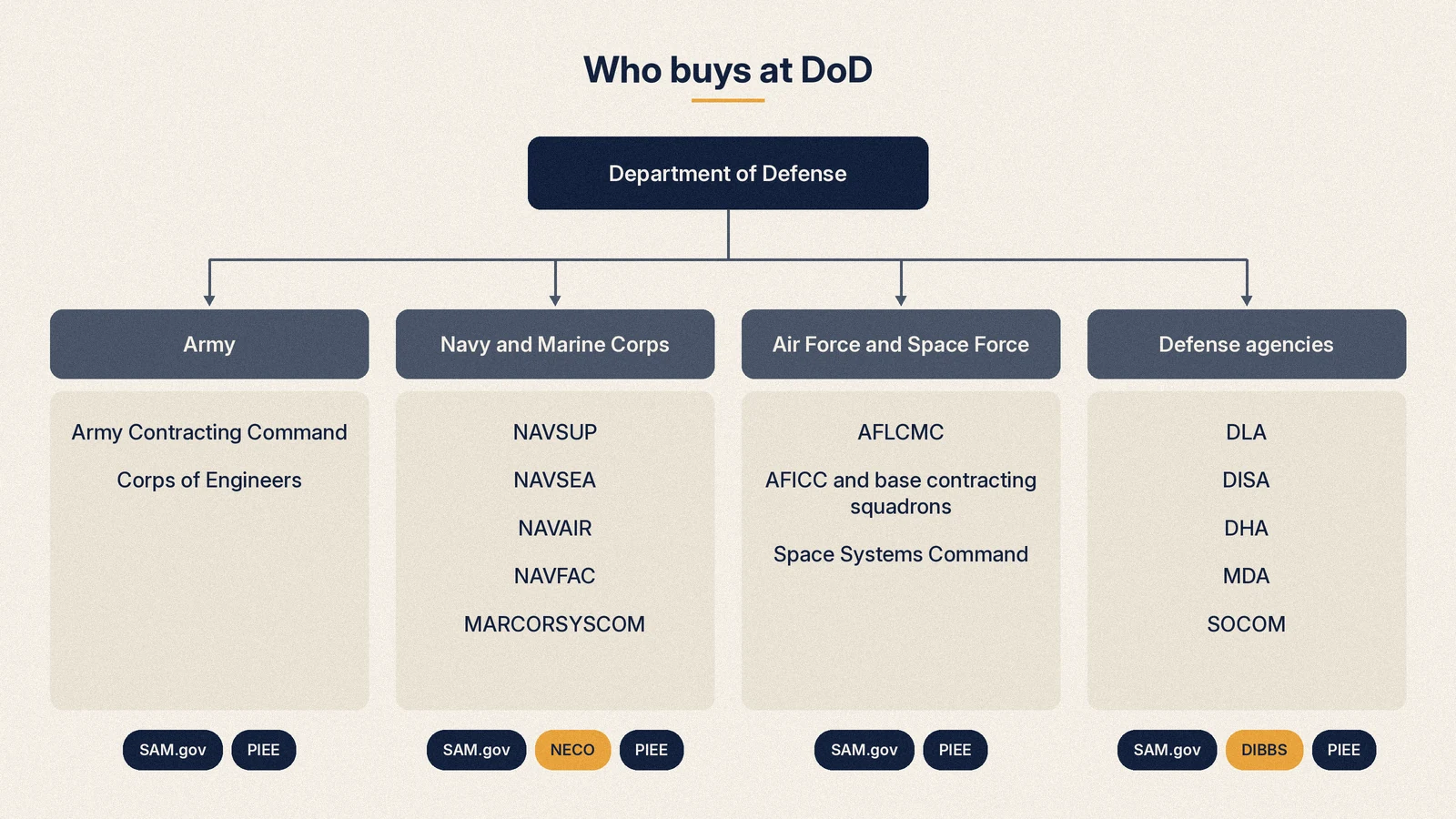
DoD contracts are bought by a few dozen separate buying commands, not by "the Pentagon" as one office, and each command posts work in its own place: SAM.gov for most solicitations, DIBBS for Defense Logistics Agency parts buys, and NECO or the PIEE Solicitation Module for some Navy and Army files. To win one, register in SAM.gov, pick the two or three commands that buy what you sell, read their award history, and bid the small and set-aside work they post every day. This guide maps who buys what, where it is posted, the DFARS and CMMC rules that trip up newcomers, and how to use award data to choose your targets.
How DoD buying actually works
The Department of Defense is the largest buyer in the federal market, and it is not one customer. Contracting authority sits with warranted contracting officers inside each military department and defense agency. A contracting officer at a Navy supply center in Pennsylvania and one at an Air Force base in Nevada work under the same rules, but they buy different things, from different vendors, through different systems.
One naming note before you search. Executive Order 14347, signed September 5, 2025, lets the department use "Department of War" as a secondary title. The order states that statutory references to the Department of Defense remain controlling, so contracts, clauses and SAM.gov records still say Department of Defense. The public website moved to War.gov, which is where the daily contract announcements now live.
Here is how DoD compares with the rest of the federal government in the award records RFPFinder has loaded from USAspending.
| Agency | Awards in our sample | Total value | Average award |
|---|---|---|---|
| Department of Defense | 62,308 | $201.7 billion | $3.24 million |
| Health and Human Services | 2,544 | $26.7 billion | $10.5 million |
| Homeland Security | 1,963 | $13.2 billion | $6.7 million |
| NASA | 799 | $12.0 billion | $15.0 million |
| Agriculture | 4,672 | $9.2 billion | $2.0 million |
| General Services Administration | 1,213 | $5.9 billion | $4.9 million |
| Veterans Affairs | 3,171 | $3.5 billion | $1.1 million |
Source: RFPFinder awards table, USAspending data, as of 2026-10-07. DoD holds 71.3% of the awards and 68.2% of the dollars in the 87,342 federal awards we track. The lower average award at DoD tells you something useful: DoD buys an enormous number of mid-size and small items, not only aircraft and ships.
The DoD buying commands and what each buys
Most first-time vendors search for "army contracts" or "air force contracts" and get flooded. It is faster to know which command inside each branch buys your product or service, then follow that command.
| Branch or agency | Main buying commands | What they mostly buy | Where they post |
|---|---|---|---|
| Army | Army Contracting Command and its centers, U.S. Army Corps of Engineers districts | Weapons and vehicle support, base services, construction and civil works | SAM.gov, some files via PIEE |
| Navy and Marine Corps | NAVSUP, NAVSEA, NAVAIR, NAVFAC, Marine Corps Systems Command | Spare parts, ships and ship repair, aircraft, facilities and construction | SAM.gov, NECO for NAVSUP parts buys, PIEE |
| Air Force and Space Force | AFLCMC, Air Force Installation Contracting Center and base contracting squadrons, Space Systems Command | Aircraft systems, base operations and construction, space systems | SAM.gov |
| Defense Logistics Agency | DLA Land and Maritime, DLA Aviation, DLA Troop Support, DLA Energy | Spare parts, food, clothing, medical supplies, construction equipment, fuel | DIBBS for RFQs, SAM.gov for larger buys |
| Defense Information Systems Agency | DITCO | Telecom and IT services | SAM.gov |
| Defense Health Agency | DHA contracting | Medical services and supplies for military health | SAM.gov |
| Missile Defense Agency | MDA contracting | Missile defense systems, engineering, R&D | SAM.gov |
| U.S. Special Operations Command | SOCOM acquisition | Specialized equipment and services, many OTAs | SAM.gov |
The open-notice data shows how lopsided the volume is. As of 2026-10-07, these are the DoD rows among the top agencies in RFPFinder's open feed.
| DoD component | Open notices | Share of open DoD notices |
|---|---|---|
| Defense Logistics Agency | 3,105 | 62.2% |
| Department of the Navy | 1,211 | 24.3% |
| Department of the Army | 425 | 8.5% |
| Department of the Air Force | 183 | 3.7% |
| Other DoD components | 69 | 1.4% |
| All DoD | 4,993 | 100% |
Two practical readings. First, if you make or distribute parts, DLA and the Navy supply commands are where the daily volume is. Second, the Army and Air Force post fewer notices, but their notices skew toward services and construction with larger values per award, which is why construction contracts are a natural entry point for builders near a base.
The geography follows the commands. Ohio and Pennsylvania are the top two states in our open feed (2,107 and 1,602 notices), which matches where DLA and NAVSUP buying offices sit in Columbus, Philadelphia and Mechanicsburg.
Where DoD posts solicitations
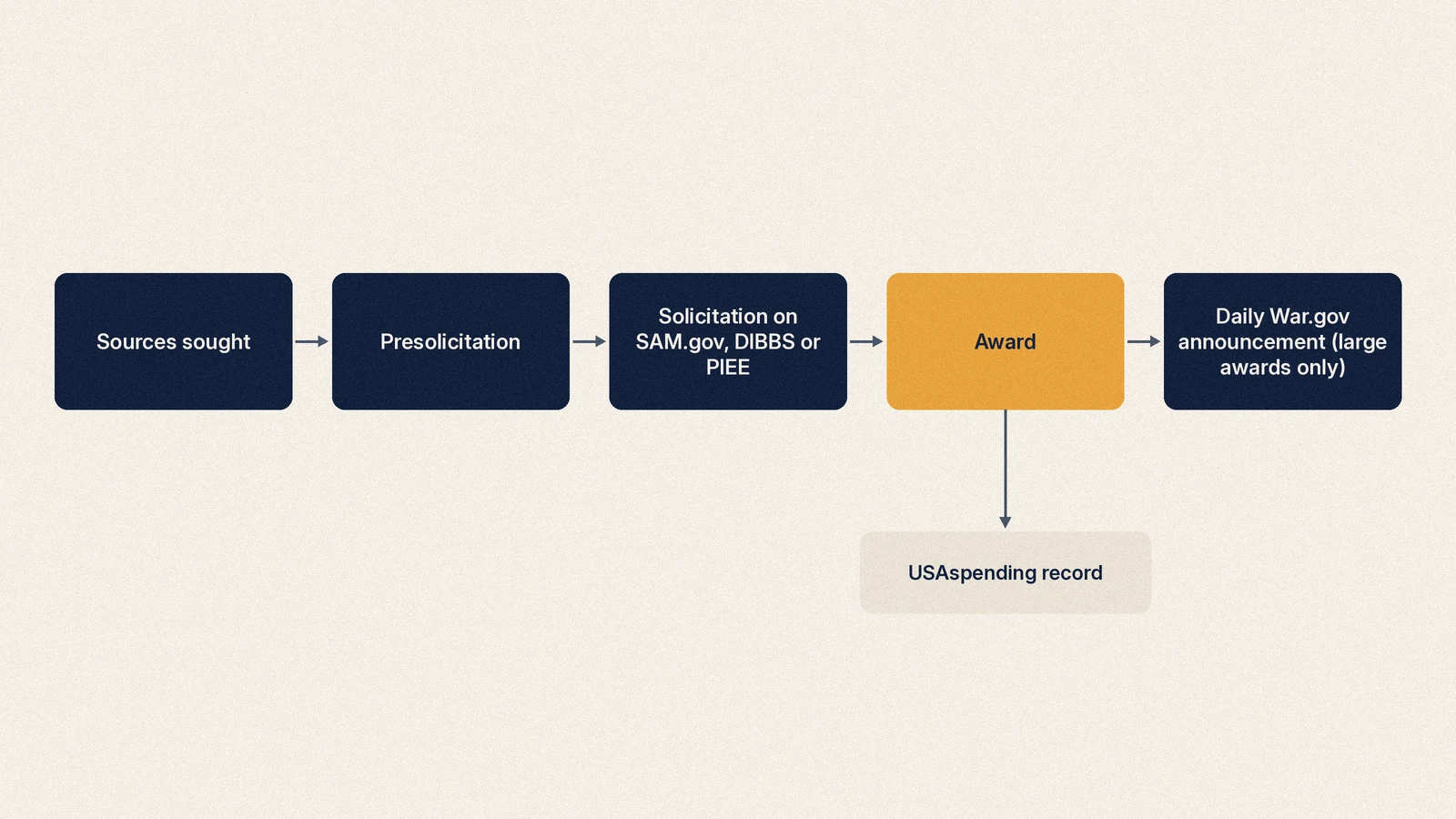
SAM.gov is the official point of entry, and FAR 5.101 requires contracting officers to synopsize proposed actions expected to exceed $25,000 there. But a large share of DoD buying happens in systems built for specific commands. Missing those systems is the most common reason a new vendor concludes "there is nothing for me."
| System | Who uses it | What you find there | What you need |
|---|---|---|---|
| SAM.gov | All of DoD | Presolicitations, solicitations, sources sought, award notices | Free account to see controlled files; active registration to be paid |
| DIBBS | Defense Logistics Agency | Automated RFQs for parts and supplies, quote submission, awards | Active SAM.gov registration and CAGE code, DIBBS vendor account |
| NECO | NAVSUP Weapon Systems Support and other Navy offices | Automated solicitations for Navy spare parts and repairs | Same SAM.gov data; quote through the posted instructions |
| PIEE Solicitation Module | Army, Navy, DLA and others | Solicitation attachments and proposal uploads | PIEE vendor account with the Proposal Manager role |
NECO is still live in 2026. RFPFinder pulled a NAVSUP solicitation from it this month with an amendment dated October 5, 2026 and quotes due November 2, 2026. DoD has pushed contracting offices toward the PIEE Solicitation Module since a 2021 policy memo, and DoD's vendor access instructions explain that only the Proposal Manager role can submit an offer. Set that role up before you need it, because the account approval can take longer than the response window.
DIBBS deserves special attention. As of 2026-10-07, 2,556 of the 3,105 open DLA notices in our feed (82%) are DIBBS RFQs, which you quote on DIBBS rather than through a SAM.gov solicitation. Our DIBBS guide covers quoting, approved-source rules and how to read the RFQ codes. For everything else, our SAM.gov search guide shows how to filter by agency, NAICS and set-aside so you see only the commands you chose.
DoD contract announcements: reading the daily list
The DoD contract announcements are the daily press releases titled "Contracts for [date]" on War.gov. They come out each business day at 5 p.m. and, in the page's own words, cover contracts "valued at $7.5 million or more." The underlying rule, DFARS 205.303, now sets the reporting threshold at actions with a face value of more than $9 million, so small actions near the bottom of the old threshold may not appear.
Each entry follows the same pattern: vendor and city, dollar value, contract type, what is being bought, where and until when the work runs, how many offers were received, and the contracting activity with the contract number. A real example from the October 6, 2026 list: Weldin Construction LLC of North Las Vegas received a ceiling $185 million IDIQ for base engineering construction at Nellis Air Force Base, Creech AFB and the Nevada Test and Training Range. It was competitive, six offers were received, and the 99th Contracting Squadron at Nellis is the contracting activity.
How to use the list as a vendor, not a reader of news:
- Find subcontracting targets. Every large IDIQ or construction award has a prime that now needs suppliers and subcontractors in that region.
- Note the contracting activity. A base contracting squadron that just awarded a $185 million construction vehicle will issue task orders, and small work under it, for years.
- Count the offers. "Six offers received" on a construction IDIQ means the field is open. "One offer" on a recurring service tells you the incumbent is entrenched.
- Track modifications. Many entries are modifications to existing contracts. Those show which programs are growing.
Searches for "dod contracts awarded" and "dod contract awards" spike in October and November, which lines up with the fiscal year-end rush at the end of September. The daily list does not include task orders under the threshold or the thousands of small purchases that make up most DoD actions. For those, use award data from USAspending.gov or the award pages RFPFinder builds from it.
Defense contractors list: who wins now
If you searched for a "defense contractors list," you probably want one of two things: the big primes to sell to, or a sense of who you would compete against. These are the top federal awardees by value in RFPFinder's USAspending sample as of 2026-10-07. They are federal totals, and nearly all of this value is defense work.
| Contractor | Awards in our sample | Total value |
|---|---|---|
| Lockheed Martin (two name variants combined) | 345 | $52.5 billion |
| The Boeing Company | 859 | $13.6 billion |
| Northrop Grumman Systems Corporation | 372 | $8.1 billion |
| Raytheon Company | 218 | $7.5 billion |
| Space Exploration Technologies Corp. | 11 | $4.5 billion |
| Aerojet Rocketdyne | 1 | $3.4 billion |
| Leidos | 119 | $3.3 billion |
| BAE Systems Land and Armaments | 53 | $2.8 billion |
Notice the name split: Lockheed Martin appears as "LOCKHEED MARTIN CORPORATION" and "LOCKHEED MARTIN CORP" in the raw data. Award databases key on the legal entity and UEI, so always check variants when you research a competitor or a teaming partner.
For a small business, this list is a customer list. Each of these primes runs a supplier portal and a small business liaison office, and each must meet subcontracting plan goals on large contracts. Your best first DoD dollar may come from a prime, not a contracting officer.
DFARS and CMMC: the rules that trip up newcomers
The Defense Federal Acquisition Regulation Supplement (DFARS) sits on top of the FAR and adds DoD-only clauses. Most are routine. A handful decide whether you can even submit an offer.
The cybersecurity stack
- DFARS 252.204-7012 requires systems that hold covered defense information to meet NIST SP 800-171 and requires you to report cyber incidents to DoD at dibnet.dod.mil within 72 hours of discovery.
- DFARS 252.204-7019 and 252.204-7020 require a NIST SP 800-171 assessment score posted in the Supplier Performance Risk System (SPRS). A Basic self-assessment counts if it is not more than 3 years old, unless the solicitation says otherwise.
- DFARS 252.204-7025 is the CMMC solicitation provision. It requires a current CMMC status in SPRS at the required level, plus a current affirmation of continuous compliance, before award.
- DFARS 252.204-7021 is the matching contract clause, which carries the CMMC requirement through performance and to your subcontractors.
Where CMMC stands in October 2026
The CMMC acquisition rule took effect November 10, 2025, which started Phase 1 (self-assessments). Phase 2, which would have required third-party Level 2 certification for most contracts handling controlled unclassified information, was scheduled for November 10, 2026. On July 13, 2026, the department announced the immediate suspension of the Phase 2 requirements. The same page states that Phase 1 self-assessment requirements remain active.
What that means in practice:
- If you handle only federal contract information (no CUI), expect Level 1 self-assessment requirements in contracts that call for CMMC.
- If you handle CUI, the 7012 safeguarding duties and the SPRS score still apply. Read the actual solicitation for the CMMC level it names.
- If a solicitation still names a third-party (C3PAO) certification, ask the contracting officer in writing whether an amendment is coming before you buy an assessment.
Other clauses that surprise first-time bidders
- Specialty metals and Berry Amendment clauses limit where certain metals, textiles and food items can come from. They matter for many DLA and Army supply buys.
- Wide Area Workflow invoicing. DFARS 252.232-7006 routes payment requests and receiving reports through Wide Area WorkFlow in PIEE. No PIEE account, no payment.
- "No substitution" and approved-source notes. As of 2026-10-07, 203 open notices in our feed carry "no substitution" language, which usually means only the listed manufacturer's part, or an approved source, qualifies.
DoD small business contracts and set-asides
DoD is required to set aside a large share of its buying for small firms, and its own supplement goes further than the FAR.
- The Rule of Two. Under FAR 19.502-2, every acquisition above the micro-purchase threshold and up to the simplified acquisition threshold must be set aside for small business when the contracting officer expects offers from two or more competitive small firms. FAR 2.101 now puts those thresholds at $15,000 and $350,000.
- DoD's construction rule. DFARS 219.502-2 tells DoD to set aside construction, including maintenance and repair, under $3.5 million, dredging under $2 million, and architect-engineer services for military construction or family housing under $1 million, unless the set-aside criteria cannot be met.
- The DoD Mentor-Protege Program. DFARS subpart 219.71 pays or credits large DoD contractors for developmental help they give to small protege firms.
Here is how set-asides break down across open federal notices in RFPFinder as of 2026-10-07. DoD dominates the federal feed, so these shares are close to what you will see at DoD.
| Set-aside type | Open federal notices |
|---|---|
| Small business (total or partial) | 1,844 |
| Service-disabled veteran-owned (SDVOSB) | 251 |
| Women-owned (WOSB) | 126 |
| HUBZone | 81 |
| 8(a) | 20 |
| Veteran-owned (VOSB) | 6 |
| Economically disadvantaged WOSB | 5 |
| Any set-aside | 2,317 of 5,731 (40.4%) |
Live, the share of open federal notices with any set-aside reads 49% (2,899 of 5,876). Free help exists: APEX Accelerators, formerly called Procurement Technical Assistance Centers, are funded by the DoD Office of Small Business Programs and provide no-cost counseling on registration, certification and bid preparation.
Side doors: SBIR/STTR, OTAs and CSOs
Not every DoD dollar flows through a FAR-based solicitation. If you have technology, these routes can be faster than a standard RFP.
SBIR and STTR
The Small Business Innovation Research and Small Business Technology Transfer programs fund R&D in phases, from a feasibility study (Phase I) to a prototype (Phase II). Authority for both programs lapsed on October 1, 2025. Congress passed S. 3971, which was signed on April 13, 2026 and reauthorizes both through September 30, 2031. The law adds DoD-specific rules for its new strategic breakthrough awards and lets agencies cap the number of proposals one company can submit starting in fiscal 2027. DoD posts its topics through the DoD SBIR/STTR Innovation Portal at dodsbirsttr.mil, not SAM.gov.
Other Transaction Agreements (OTAs)
10 U.S.C. 4022 lets DoD fund prototype projects through other transactions, which are not bound by most of the FAR. One of four conditions must be met. The two that matter most to small firms: at least one nontraditional defense contractor participates to a significant extent, or every significant non-government participant is a small business or nontraditional contractor. A successful prototype can lead to a follow-on production award without a new competition. Many OTAs are run through industry consortia, so joining the consortium for your technology area is often the first step.
Commercial Solutions Openings (CSOs)
CSOs are broad calls for innovative commercial solutions, used by organizations such as the Defense Innovation Unit. You submit a short brief or pitch first, and only selected firms are asked for a full proposal.
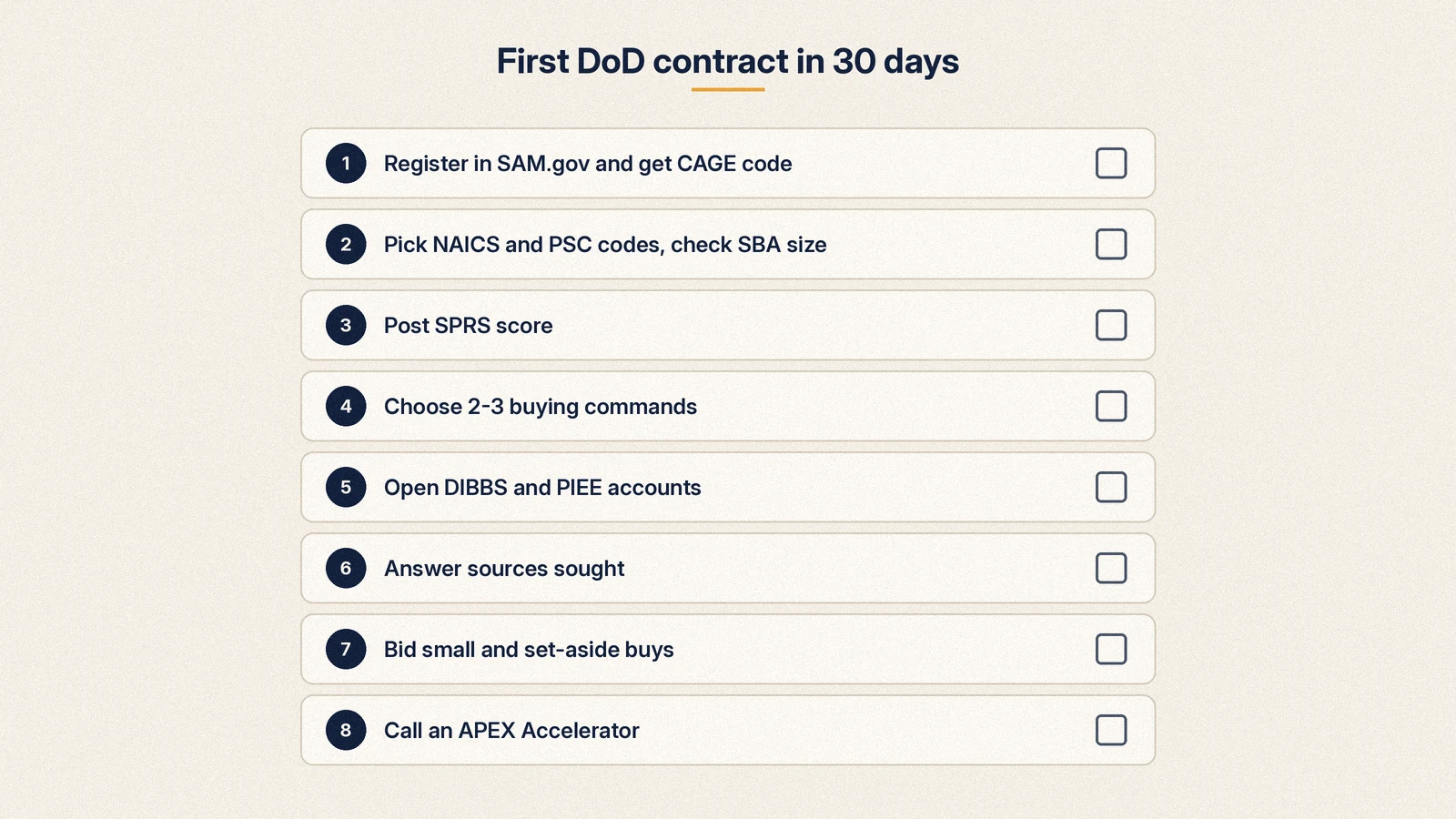
How to get DoD contracts: a 30-day plan
This sequence works for a firm with a real product or service and no DoD history.
- Register in SAM.gov for all awards, and confirm your CAGE code is assigned. DIBBS, PIEE and payment all key on it.
- Pick your NAICS and PSC codes and confirm your size against the SBA standard for each NAICS code you will bid under.
- Post an SPRS score. If there is any chance you will touch CUI, do a NIST SP 800-171 Basic self-assessment and post it, so a 7019 or 7025 provision does not knock you out.
- Choose two or three commands from the table above that buy what you sell, based on award history rather than reputation.
- Open your portal accounts: DIBBS if you sell parts or supplies, PIEE with the Proposal Manager role, and saved searches on SAM.gov for your commands and codes.
- Answer sources sought notices from those commands. As of 2026-10-07, 698 sources sought and RFI notices are open in our feed, and responses drive set-aside decisions.
- Bid small and often. DLA RFQs and set-aside buys under $350,000 are where past performance starts.
- Call an APEX Accelerator and the small business specialist at your target command before you bid on anything large.
Using award history to target DoD contracting offices
A "dod contracting offices" search gives you a directory. What you need is a ranking: which office buys your item often, from many vendors, at a size you can handle. Award history answers that.
Start with the top NAICS codes in RFPFinder's open feed as of 2026-10-07. Most of them are defense supply codes.
| NAICS | Description | Open notices |
|---|---|---|
| 336413 | Other aircraft parts and auxiliary equipment manufacturing | 383 |
| 237310 | Highway, street and bridge construction | 312 |
| 333998 | All other miscellaneous general purpose machinery manufacturing | 227 |
| 334417 | Electronic connector manufacturing | 186 |
| 332911 | Industrial valve manufacturing | 134 |
| 237990 | Other heavy and civil engineering construction | 130 |
| 334412 | Bare printed circuit board manufacturing | 124 |
| 541715 | R&D in the physical, engineering and life sciences | 121 |
| 332510 | Hardware manufacturing | 110 |
| 236220 | Commercial and institutional building construction | 109 |
The codes cover all open notices, and the highway and heavy civil lines likely include state transportation work, but the parts and electronics codes come almost entirely from DLA and Navy supply buys. That is why supplies and equipment is the largest category on the site.
Then look at competition. RFPFinder labels each open notice using award history from the same office and product code plus the notice text. As of 2026-10-07:
| Competition label | Open notices | Share |
|---|---|---|
| Likely competitive | 3,039 | 40.6% |
| Incumbent-favored | 1,846 | 24.6% |
| Competition unknown | 2,565 | 34.2% |
| Sole-source | 43 | 0.6% |
The signals behind those labels are specific. The most common is "4 different vendors won the last 5 awards from this office" for a given product code, which on 451 open notices points to PSC 59, electrical and electronic components. When one vendor has won 3 of the last 5, we flag it as a repeat winner. Offices with spread-out winners are where a new vendor has a real chance.
Finally, plan for recompetes. As of 2026-10-07, RFPFinder lists 14,877 federal contracts worth $100,000 or more that expire in the next 12 months, with $78.3 billion in total value. The recompetes list filters them by agency, so you can see which DoD contracts in your codes end soon and start talking to the office before the new solicitation appears.
Common mistakes
- Searching only SAM.gov. Most open DLA notices in our feed are RFQs on DIBBS, and some Navy work is still posted on NECO.
- Chasing the daily War.gov list. Those are finished awards over the announcement threshold. Use them to find primes and offices, not to find work to bid tomorrow.
- Ignoring the SPRS score. A missing NIST SP 800-171 assessment can make you ineligible even when the work has nothing to do with IT.
- Buying a CMMC certification nobody asked for. Phase 2 is suspended. Read the CMMC level in the actual solicitation and ask in writing if it conflicts with current guidance.
- Assuming the Air Force or Army is one customer. Base contracting squadrons and Army contracting centers each have their own buyers, needs and award patterns.
- Bidding "no substitution" parts without approval. If the notice names an approved source, an unapproved offer is usually rejected.
- Skipping the PIEE Proposal Manager role. Without it you cannot upload an offer, and access requests do not clear in a day.
- Treating name variants as different companies. Search both "Corp" and "Corporation" spellings, and confirm by UEI.

What RFPFinder shows you
RFPFinder pulls DoD notices from SAM.gov and DLA's DIBBS into one searchable list next to state and local bids, without a portal login to read the documents we store.
- All DoD notices in one feed. As of 2026-10-07, 4,993 open DoD notices, including 2,556 DIBBS RFQs, out of 5,876 open federal notices and 9,682 open bids overall. See what we cover.
- Competition labels on every notice. Likely competitive, incumbent-favored or sole-source, with the award evidence shown.
- Incumbents and recompetes. The recompetes page lists federal contracts ending in the next 12 months, and each notice links to past awards from the same office.
- Category and code browsing. Start from supplies, construction or NAICS codes and filter to DoD.
- Daily alerts. Free daily digests for one category or state, with paid plans for more filters on the pricing page.
Questions
How do I find DoD contracts to bid on?
Search SAM.gov for presolicitations, solicitations and sources sought notices filtered to Department of Defense, and add DIBBS if you sell parts or supplies to the Defense Logistics Agency. Some Navy parts buys still post on NECO, and some solicitation files sit in the PIEE Solicitation Module. As of 2026-10-07, RFPFinder tracks 4,993 open DoD notices from these sources in one list.
Where are the daily DoD contract announcements published?
They are published each business day at 5 p.m. on War.gov under News, Contracts, with one page per date titled Contracts for that day. The page describes itself as covering contracts valued at $7.5 million or more, while DFARS 205.303 now sets the reporting threshold at more than $9 million. Each entry names the vendor, value, work, number of offers and the contracting activity.
Is the Department of Defense now called the Department of War?
Executive Order 14347, signed September 5, 2025, allows Department of War as a secondary title. The order says statutory references to the Department of Defense remain controlling, so contracts, clauses and SAM.gov still use Department of Defense. The public website and contract announcements moved to War.gov.
Do I need CMMC certification to win a DoD contract?
Only if the solicitation requires a CMMC level, and the requirement depends on the information you will handle. Phase 2 third-party certification, planned for November 10, 2026, was suspended on July 13, 2026, while Phase 1 self-assessments remain active. DFARS 252.204-7012 safeguarding and SPRS assessment scores still apply when the clauses are in your contract.
What is DIBBS and do I need it?
DIBBS is the Defense Logistics Agency Internet Bid Board System, where DLA posts automated requests for quotations and vendors submit quotes. You need it if you sell spare parts, supplies or equipment that DLA buys. As of 2026-10-07, 2,556 of the 3,105 open DLA notices RFPFinder tracks are DIBBS RFQs.
How do small businesses get DoD contracts?
Register in SAM.gov, confirm your size under the SBA standard for your NAICS codes, post a NIST SP 800-171 score in SPRS if you may handle controlled information, then bid set-aside and small buys from two or three commands that buy what you sell. Under the FAR Rule of Two, buys up to the $350,000 simplified acquisition threshold are set aside for small business when two capable small firms are expected, and DFARS 219.502-2 sets aside DoD construction under $3.5 million. APEX Accelerators give free help.
Which companies get the most DoD contract dollars?
In RFPFinder's USAspending sample as of 2026-10-07, the top federal awardees by value are Lockheed Martin at $52.5 billion across two name variants, Boeing at $13.6 billion, Northrop Grumman at $8.1 billion and Raytheon at $7.5 billion. Nearly all of that value is defense work. For small firms these primes are customers as well as competitors, because they subcontract to meet small business plan goals.
Are SBIR and STTR still available at DoD?
Yes. Authority lapsed on October 1, 2025, and S. 3971, signed April 13, 2026, reauthorized both programs through September 30, 2031. DoD posts SBIR and STTR topics on the DoD SBIR/STTR Innovation Portal at dodsbirsttr.mil rather than as standard SAM.gov solicitations.
What is an OTA in defense contracting?
An Other Transaction Agreement is a non-FAR agreement DoD can use for prototype projects under 10 U.S.C. 4022. It generally requires significant participation by a nontraditional defense contractor, all-small-business or nontraditional participants, or a one-third non-federal cost share. A successful prototype can lead to a follow-on production award without a new competition.
Related guides
- How to find RFPs (and government contracts) without paying for a database8 min read
- Government contracts for small business: how to get started9 min read
- Set-aside certifications: 8(a), HUBZone, SDVOSB, WOSB7 min read
- RFP vs RFQ vs RFI (and IFB, sources sought and more)6 min read
- How to write an RFP response that gets scored9 min read
- Bid Tabulations and Bid Results: Who Bid, Who Won and at What Price17 min read
- CAGE code lookup, UEI lookup and DUNS: find, read and use all three IDs16 min read
- DIBBS explained: how DLA bids, automated awards and approved sources work17 min read
- "GSA Schedule Contracts in 2026: What MAS Is, Who Should Apply, How Orders Flow"17 min read
- How to Bid on Government Contracts: From Zero to a Submitted Bid18 min read
- "SAM.gov Search: Every Filter, Notice Type and Alert, Explained for Vendors"17 min read
- Sources sought notices: the cheapest way to shape a federal contract16 min read