
To bid on a government contract, you register your business (SAM.gov for federal work, the state or local vendor portal for everything else), find an open solicitation that matches what you sell, read every section and amendment, and submit each required document through the exact channel the solicitation names before the deadline. The catch is timing: SAM.gov tells new registrants to allow at least ten business days, and more than a quarter of the federal notices we track close in under two weeks. Register first, then hunt.
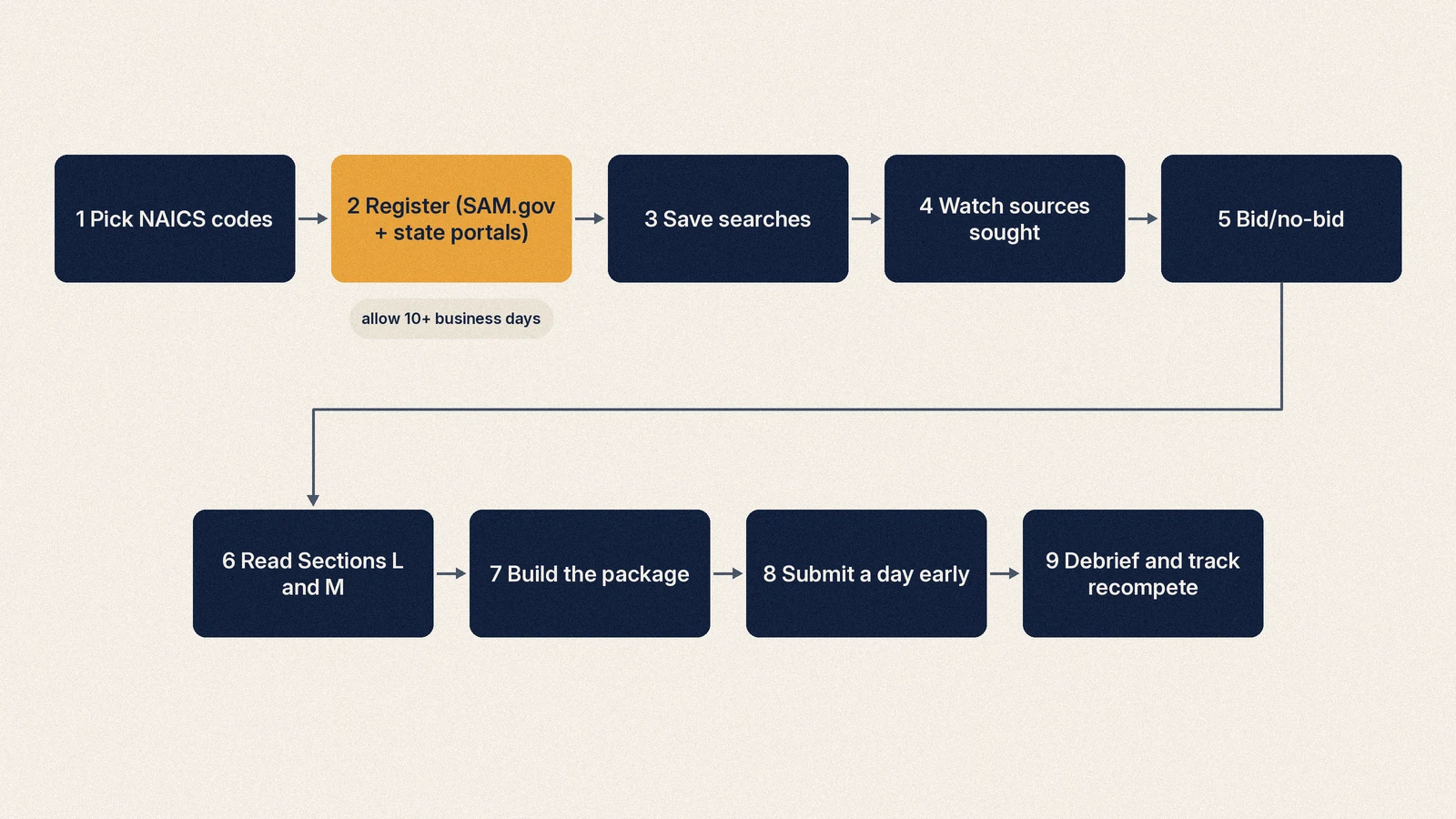
The bid path at a glance
Every public bid, federal or local, follows the same nine steps. The order matters because the slow steps (registration, certifications, bonding) cannot be rushed once a deadline is running.
- Pick your codes. Find your NAICS codes and product or service codes, and check your size against the SBA size standard for each one.
- Register. SAM.gov for federal; the state portal plus any city, county or school district portals you want to sell to.
- Set up a search. Save searches on SAM.gov and turn on email notices in each state portal, or use one aggregated list.
- Read early notices. Sources sought and presolicitation notices tell you what is coming before the clock starts.
- Qualify the bid. Check eligibility, set-aside, scope fit, bonding, insurance, site visits and price competitiveness.
- Read the solicitation twice. Once for the requirement, once for the instructions and evaluation criteria.
- Build the package. Forms, technical response, price schedule, certifications and every amendment acknowledgment.
- Submit early. Through the named portal or email, at least a day before the deadline.
- Follow through. Request a debriefing if you lose, and track the award for the recompete.
Here is how the clock works in practice, using the rules in the current FAR (FAC 2026-01) and SAM.gov's own guidance.
| Step | Typical time or rule | Source |
|---|---|---|
| SAM.gov registration goes active | Allow at least 10 business days after you submit | SAM.gov entity registration checklist |
| SAM.gov renewal | Every 365 days | SAM.gov |
| Federal notice before a solicitation is issued | At least 15 days (shorter for commercial buys) | FAR 5.203(a) |
| Federal response window above $350,000, non-commercial | At least 30 days (45 for R&D) | FAR 5.203(c), (d) |
| Average federal notice stays open | 30.8 days (5,272 notices) | RFPFinder, as of 2026-10-07 |
| Average state notice stays open | 43.7 days (555 notices) | RFPFinder, as of 2026-10-07 |
| Request a federal debriefing after award | Within 3 days of notification | FAR 15.506 |
| File a GAO protest against an award | Within 10 days of knowing the basis | GAO bid protest FAQ |
Before you register: codes, size and which government to sell to
Registration forms ask for your codes, so settle them first.
NAICS codes classify what your business does. Look yours up with the Census Bureau NAICS tool. Most firms list a primary code and several secondary ones. Product and service codes (PSCs) describe what the government buys; they are optional in SAM.gov but useful for searching, and the PSC manual lists them.
Size is measured per NAICS code. SBA publishes a size standard for each code, usually in annual receipts or employee count. You can be small under one code and large under another, which matters because every set-aside is tied to the NAICS code on the solicitation. If you plan to pursue 8(a), HUBZone, WOSB or SDVOSB work, our small business contracting guide and certifications guide cover the programs; this guide stays on the bid itself.
Level of government decides which portals you need. Federal buyers post on SAM.gov. States, counties, cities, school districts and universities each post on their own systems. Here is what governments are buying in the open notices RFPFinder tracks right now.
| Category | Open notices (as of 2026-10-07) |
|---|---|
| Supplies & Equipment | 4,784 |
| Construction | 1,326 |
| Equipment Maintenance & Repair | 554 |
| IT & Software | 207 |
| Consulting | 199 |
| Real Estate & Facilities | 142 |
| Architecture & Engineering | 136 |
| Janitorial & Cleaning | 119 |
| Landscaping | 107 |
| Transportation | 84 |
A notice can sit in more than one category, so the rows overlap. Browse any of them live at /categories/.
Get registered: SAM.gov and state vendor portals
SAM.gov for federal bids
Federal offerors must be registered in SAM at the time they submit an offer or quote (FAR 4.1102). Registration is free: SAM.gov states plainly that there is no charge to get a Unique Entity ID, register or renew. Companies that charge for "SAM registration" are selling form-filling, not access.
The entity registration checklist breaks an All Awards registration into six parts. Gather these before you log in:
- Unique Entity ID: legal business name, physical address (no PO box), date and state of incorporation. The old DUNS number is no longer used; SAM.gov issues the UEI.
- Core data: TIN, IRS consent, fiscal year end, banking details for electronic funds transfer, and a CAGE code. If you have no CAGE code, one is assigned after you submit.
- Assertions: NAICS codes, optional PSCs, and size metrics (annual receipts and employees, as defined in 13 CFR 121).
- Representations and certifications: the standard FAR answers (debarment, tax delinquency, affirmative action, Service Contract Labor Standards and more) that agencies otherwise ask for in every solicitation.
- Points of contact: Accounts Receivable, Electronic Business and Government Business POCs are mandatory.
- SBA supplemental page: if you selected a small business NAICS code, this feeds the SBA's Small Business Search profile that contracting officers use for market research.
Allow at least ten business days after submitting. If your TIN or CAGE validation fails, SAM.gov emails the Government Business POC with instructions, so check spam. Put the 365-day renewal date in your calendar: an expired registration means you cannot submit a federal offer.
State and local vendor portals
States run their own registration, and most of it is free. Of the 51 state and DC portals in RFPFinder's portal file, 17 record vendor registration as free, Texas charges $70 a year for its Centralized Master Bidders List, West Virginia charges $125 a year once purchase orders exceed $5,000 in aggregate, and Hawaii charges the awardee 0.75% of the award, capped at $5,000. The rest we have not yet verified.
Document access varies more than people expect. In our portal file, 27 portals let you read solicitation documents without logging in, 5 require a login, and 19 are not yet verified. Here are the states with the most open notices we track, plus a few large systems.
| State | Portal | Login needed to view documents? | Login needed to submit? | Vendor fee |
|---|---|---|---|---|
| Ohio | OhioBuys | No | Yes | Not verified |
| Pennsylvania | PA eMarketplace | No | Yes | Not verified |
| New York | NYS Contract Reporter | Yes | Not verified | Free |
| Georgia | Georgia Procurement Registry | Not verified | Not verified | Not verified |
| California | Cal eProcure | No | Not verified | Not verified |
| Virginia | eVA | No | Yes | Free |
| Texas | ESBD | No | Not verified | $70 per year (CMBL) |
| North Carolina | NC eVP | No | Yes | Not verified |
| Illinois | BidBuy | Not verified | Not verified | Not verified |
| Florida | MyFloridaMarketPlace VBS | Yes | Not verified | Not verified |
| Massachusetts | COMMBUYS | No | Yes | Free |
| Maryland | eMMA | No | Yes | Free |
| Colorado | ColoradoVSS | No | Yes | Free |
| Oregon | OregonBuys | Yes | Yes | Free |
| Washington | WEBS | Not verified | Not verified | Free |
Cities, counties and school districts usually run separate systems, sometimes on the same software a state uses (Bonfire, Public Purchase, Periscope). A vendor account on the state portal rarely carries over to a city. Registering on every portal in your service area is tedious, but it is the only way to receive each buyer's own notices and addenda.
Where to find government bids, including bids near you
Federal: SAM.gov and DIBBS
Federal agencies must synopsize proposed contract actions expected to exceed $25,000 on SAM.gov, and must post actions between $20,000 and $25,000 in a public place (FAR 5.101). That makes SAM.gov's Contract Opportunities search the starting point. Filter by NAICS, set-aside, place of performance and notice type, save the search, and check it daily.
Defense buyers dominate the open federal list. As of 2026-10-07, RFPFinder tracks 5,731 open federal notices, and these agencies post the most:
| Agency | Open notices |
|---|---|
| Defense Logistics Agency | 3,105 |
| Department of the Navy | 1,211 |
| Department of the Army | 425 |
| Department of Veterans Affairs | 199 |
| Department of the Air Force | 183 |
| GSA Public Buildings Service | 55 |
| Department of State | 51 |
| Federal Bureau of Prisons | 42 |
Defense agencies account for 4,993 of the 5,731 open federal notices, and 2,556 of the open notices run through DLA's Internet Bid Board System (DIBBS), which has its own quote process. If you sell parts or supplies, DIBBS is likely your main channel.
State and local
State notices go on the state portals in the table above. Local notices live on city, county, school district and university sites. As of 2026-10-07, RFPFinder's open notices break down like this by level:
| Level | Open notices | Share |
|---|---|---|
| Federal | 5,731 | 71.5% |
| State | 1,290 | 16.1% |
| City | 325 | 4.1% |
| County | 288 | 3.6% |
| University | 155 | 1.9% |
| Other | 123 | 1.5% |
| School district | 106 | 1.3% |
We pull from 8 sources covering 591 agencies, and our local coverage is still growing, so read the local rows as what we index today, not the whole local market. Many local buyers still post only on their own websites.
Bids near me
For "government contracts near me", combine three filters: your state portal, the portals of the cities and counties within your service radius, and SAM.gov's place of performance filter. Local work often requires mandatory site visits or pre-bid meetings, which favors firms within driving distance. RFPFinder groups federal, state and local notices by state at /states/.
Before the solicitation
The best bids start before the notice. Agencies publish procurement forecasts, and sources sought notices ask who can do the work. As of 2026-10-07 we track 698 open sources sought notices. Answering one costs a few pages and can shape whether the buy becomes a set-aside. Past awards on USAspending.gov show who won before and at what price, and SBA's SubNet lists subcontracting opportunities from primes.
How long a government bid stays open
This is the number most guides skip, and it decides whether a bid is feasible. RFPFinder measures how many days each notice stays open, from posting to its response deadline. As of 2026-10-07:
| Agency type | Notices measured | Average days open |
|---|---|---|
| Federal | 5,272 | 30.8 |
| State | 555 | 43.7 |
| City | 322 | 31.9 |
| County | 287 | 31.9 |
| University | 145 | 31.9 |
| School district | 105 | 31.5 |
Averages hide the short windows. Here is the spread:
| Window | Federal | State | City | County | School |
|---|---|---|---|---|---|
| Under 7 days | 1.3% | 1.3% | 0% | 0.3% | 0% |
| 7 to 13 days | 26.1% | 3.8% | 5.0% | 2.8% | 6.7% |
| 14 to 29 days | 36.9% | 47.2% | 38.5% | 46.7% | 35.2% |
| 30 to 59 days | 26.9% | 35.5% | 54.0% | 47.4% | 58.1% |
| 60 days or more | 8.8% | 12.3% | 2.5% | 2.8% | 0% |
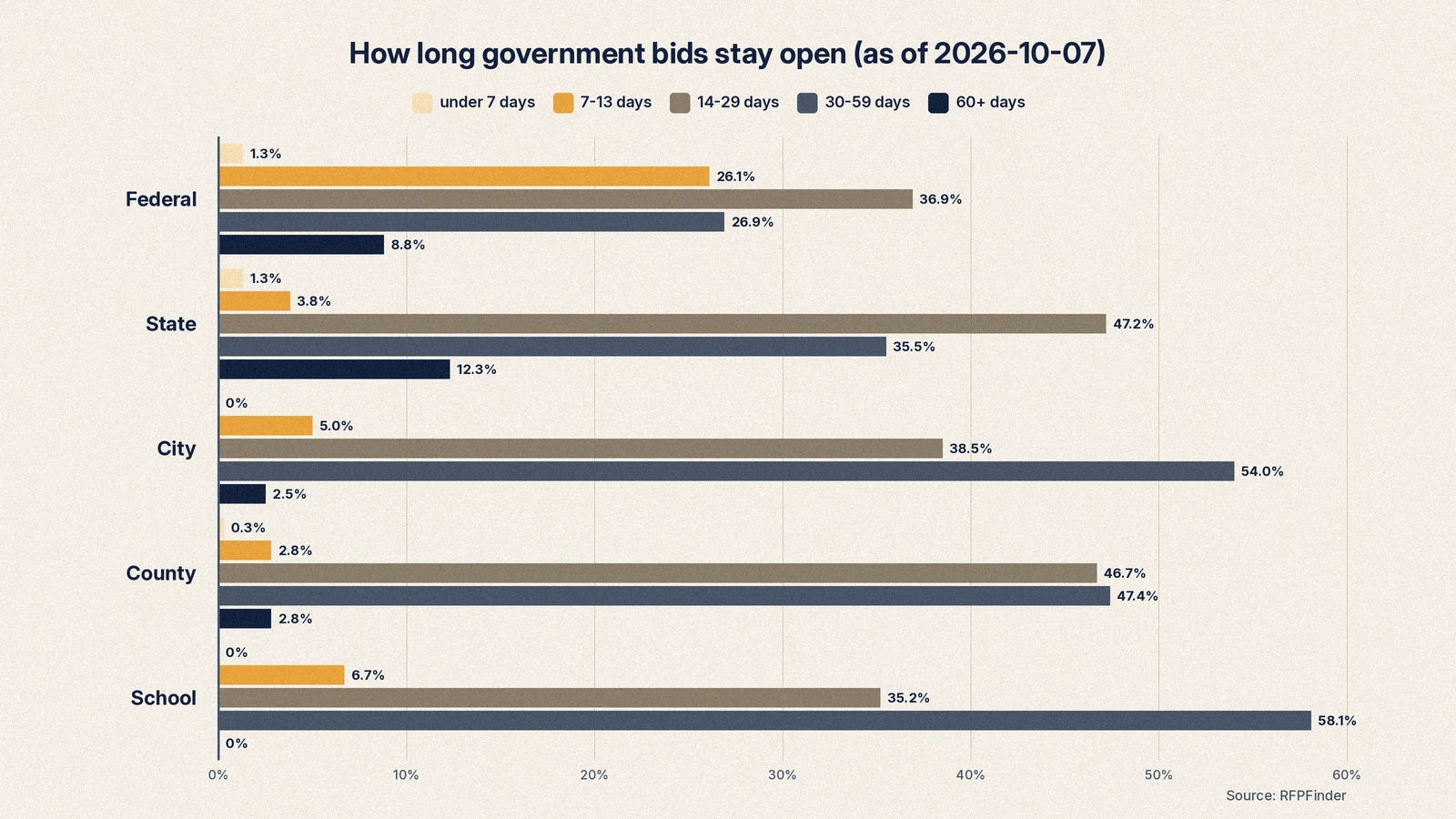
Three things follow.
- Federal windows are bimodal. 1,441 of 5,272 federal notices (27%) close in under 14 days, while 466 (9%) run 60 days or more. FAR 5.203 lets contracting officers set short response times for commercial buys and for purchases under $350,000, as long as the time is reasonable. Only non-commercial buys above $350,000 must allow at least 30 days.
- State work gives you the most time. The state average is 43.7 days, and 12% of state notices run 60 days or more.
- Local buyers cluster at two to eight weeks. 93% of city notices and 94% of county notices give you 14 to 59 days.
The practical rule: if SAM.gov needs at least ten business days and a quarter of federal notices close in under two weeks, a business that registers after spotting a bid will miss many of them. Register and set up searches before you need them.
Read the solicitation and make a bid/no-bid call
Know the notice type
As of 2026-10-07, RFPFinder's open notices split into 3,993 solicitations, 3,062 combined synopsis/solicitations and 963 presolicitations. A presolicitation announces a buy that is coming; you cannot bid on it yet. A solicitation (RFP, RFQ or IFB) is biddable. A combined synopsis/solicitation is the short form used for commercial products and services: the notice itself is the solicitation, often with a short window. Sources sought and RFIs are market research. Our RFP vs RFQ vs RFI guide explains each type.
Find the parts that decide the award
Federal solicitations in the uniform contract format put the rules in two places. Section L tells you how to prepare and submit the proposal: volumes, page limits, fonts, file formats, where to send it. Section M tells you how it will be evaluated. Commercial solicitations use addenda to FAR 52.212-1 (instructions) and 52.212-2 (evaluation) for the same purpose. The requirement itself sits in the statement of work (SOW) or performance work statement (PWS). State and local RFPs usually have an "instructions to bidders" section and a scoring table.
Then check amendments. Federal amendments are issued on Standard Form 30 and must be acknowledged; state and local addenda usually come with a signature page. Answers to vendor questions are often published as an amendment, so read every one.
Run a ten-minute bid/no-bid check
- Eligible? Is it set aside, and are you small under the solicitation's NAICS code? If you are not eligible, stop.
- Registered? Is your SAM.gov or portal registration active, and will it still be active on the due date?
- Scope fit? Can you perform the major tasks yourself, not just one minor line?
- Past performance? Do you have similar work to cite, or relevant commercial or subcontract work?
- Bonding and insurance? Can you get the bid bond and the insurance limits required?
- Mandatory events? Is there a required pre-bid meeting or site visit you can attend?
- Price? Do past awards on USAspending or the buyer's award page suggest you can be competitive?
- Time? Can you build a compliant package in the days left?
Set-asides matter in that first question. Federal rules require contracting officers to set aside buys above the $15,000 micro-purchase threshold and up to the $350,000 simplified acquisition threshold when they expect offers from two or more responsible small businesses (FAR 19.502-2; thresholds in FAR 2.101). Of the open federal notices on RFPFinder today, 49% (2,899 of 5,877) carry a set-aside. As of 2026-10-07 the split was:
| Set-aside type | Open federal notices |
|---|---|
| Small business | 1,844 |
| Service-disabled veteran-owned (SDVOSB) | 251 |
| Women-owned (WOSB) | 126 |
| HUBZone | 81 |
| 8(a) | 20 |
| Veteran-owned (VOSB) | 6 |
| Economically disadvantaged women-owned (EDWOSB) | 5 |
What goes into a government bid
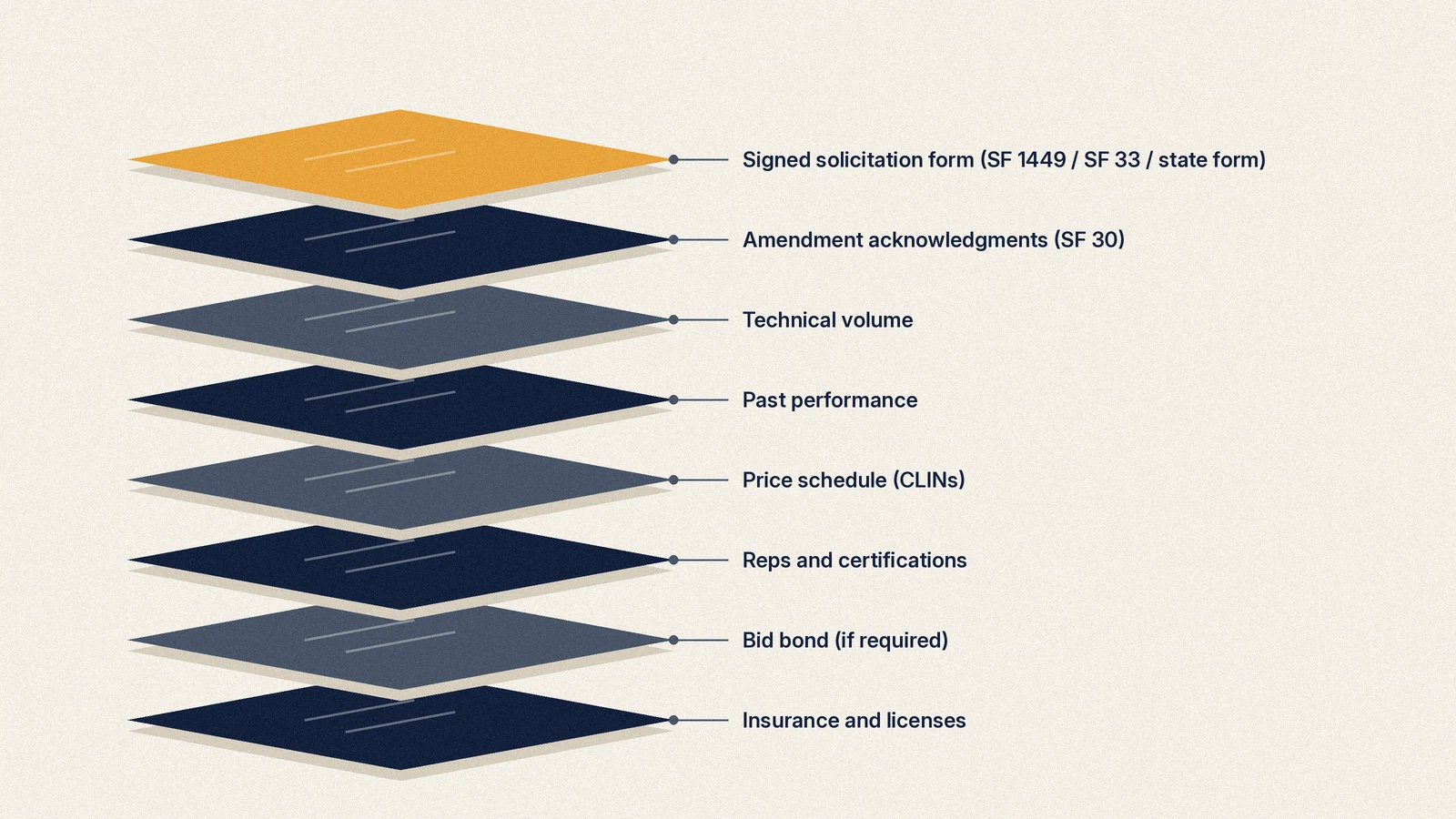
A government bid is a package, and every piece is checked before anyone reads your pitch. This is what a typical package contains; the solicitation always controls.
| Component | What it is | Notes |
|---|---|---|
| Signed solicitation form | SF 1449 (commercial), SF 33 (negotiated), SF 1442 (construction), SF 18 (quotes), or the state's bid form | Unsigned or wrong-version forms are a common rejection |
| Amendment acknowledgments | SF 30 or signed addenda pages | Acknowledge every one, even if nothing changed for you |
| Technical volume | How you will do the work, mapped to the SOW or PWS | Follow Section L's structure and page limits exactly |
| Management and staffing | Key personnel, resumes, organization | Often scored as its own factor |
| Past performance | References or questionnaires for similar contracts | Required for evaluation above $350,000 unless the CO documents otherwise (FAR 15.304) |
| Price schedule | Line item (CLIN) pricing or a bid schedule | Price every line asked; do not add terms |
| Representations and certifications | FAR answers in SAM.gov, plus solicitation-specific ones; state non-collusion and tax affidavits | Federal reps are mostly answered once in SAM.gov |
| Bid guarantee | Bid bond or other guarantee when required | Federal: at least 20% of the bid price, capped at $3 million (FAR 28.101-2) |
| Insurance and licenses | Certificates of insurance, state contractor licenses | Local construction and services often require these at bid time |
Federal construction contracts above $150,000 need performance and payment bonds after award under the Miller Act (FAR 28.102-1), so line up your surety before you bid, not after you win.
For how to write the technical and price volumes so they score well, see how to write an RFP response.
How government bids are evaluated: sealed bid, LPTA and best value
Section M or the scoring table tells you which method applies. It changes how you should write and price.
| Method | How the winner is chosen | What it means for your bid |
|---|---|---|
| Sealed bidding (IFB, FAR Part 14) | Award to the responsible bidder whose conforming bid is most advantageous on price and price-related factors; bids opened publicly; no discussions | Compliance and price are everything. A nonconforming bid is rejected, not fixed |
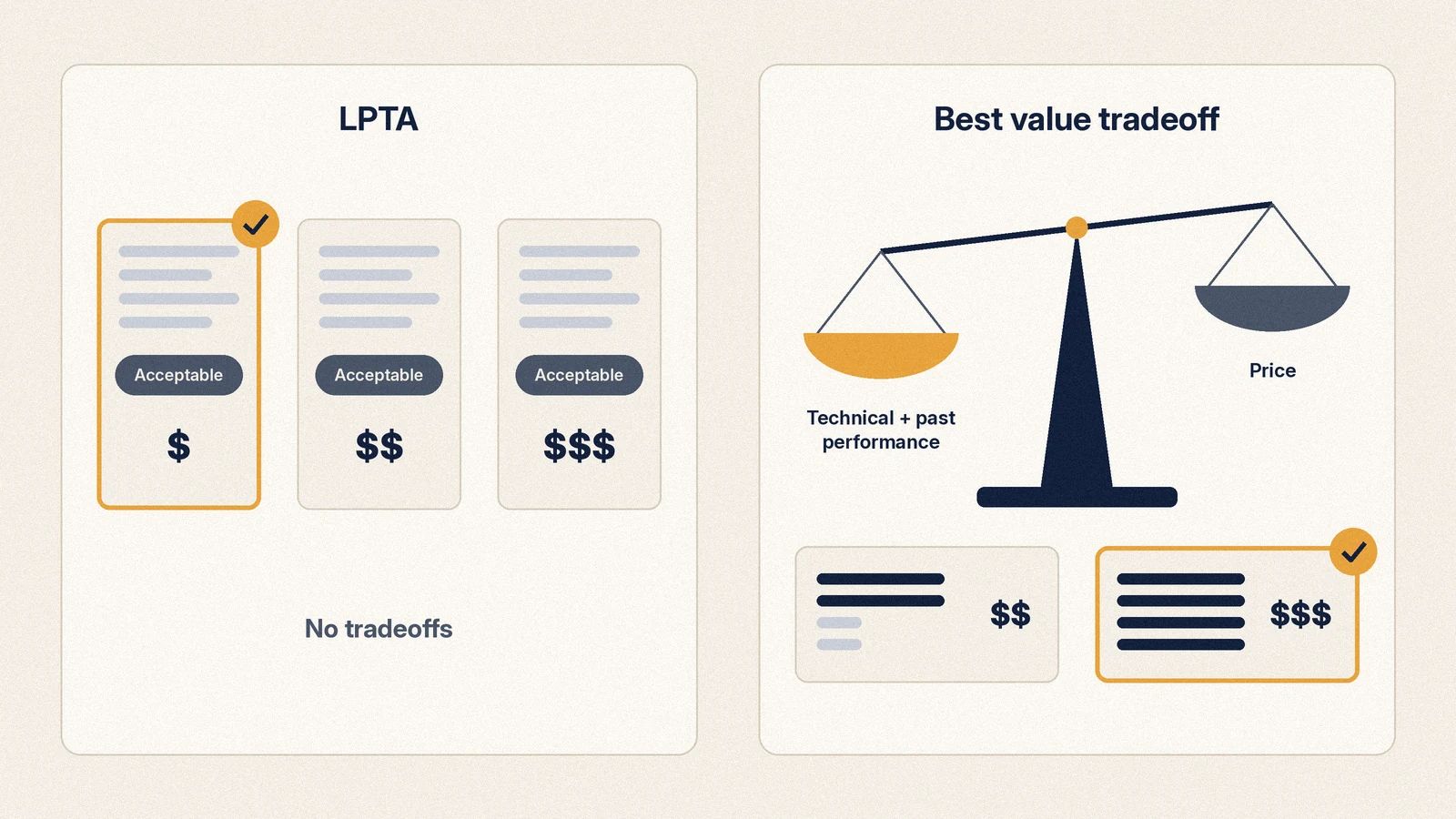
| Lowest price technically acceptable (FAR 15.101-2) | Proposals rated acceptable or unacceptable; lowest price among acceptable ones wins; tradeoffs are not permitted | Meet every minimum clearly, then sharpen price. Extra features earn nothing |
| Best value tradeoff (FAR 15.101-1) | Technical, past performance and price weighed per the stated weights; the agency may pay more for a better proposal | Write to the scored factors and show strengths the evaluator can cite |
| Simplified acquisition (FAR Part 13) | Streamlined quotes for buys up to $350,000; the basis of award is stated in the RFQ | Short responses, fast cycles; good first bids |
| State and local | Low responsive, responsible bid for many construction IFBs; points-based scoring for RFPs | Read the scoring table and the local preference rules |
Two rules apply across federal methods. Price or cost must be evaluated in every source selection, and the solicitation must say whether non-price factors combined are significantly more important than, approximately equal to, or significantly less important than price (FAR 15.304). That sentence tells you how hard to push on price.
LPTA has limits. Civilian agencies may use it only when six conditions are met, including that the agency would get little value from exceeding the minimum. The Defense Department must avoid it for IT, cybersecurity, systems engineering and similar knowledge-based services, and cannot use it for audit work (DFARS 215.101-2-70).
Winning on paper is not the end. The contracting officer must also find you responsible: adequate finances, capacity, integrity and a satisfactory record (FAR 9.104-1). If a small business's low offer is rejected on responsibility grounds, the case goes to SBA, which can issue a Certificate of Competency requiring the award.
Submit on time, then follow through
Submit through the named channel
SAM.gov publishes notices; it is usually not where you submit. The solicitation names the method: an email address, an agency system such as DIBBS or PIEE, or a state portal upload. Use exactly that method, name files the way Section L asks, and stay under file size limits.
Upload at least a day early. Under FAR 15.208, a proposal received after the exact time is late and is not considered unless narrow exceptions apply, such as an electronic proposal that reached the government's initial point of entry by 5:00 p.m. one working day before the deadline. State portals usually lock at the closing time. A slow upload at 4:58 p.m. is your problem, not the buyer's.
Ask questions early too. Most solicitations set a question deadline well before the due date, and answers come back as amendments.
After you submit
- If you win: watch for the award notice, sign promptly, and supply any bonds or insurance certificates required after award.
- If you lose a federal negotiated procurement: request a debriefing in writing within 3 days of notification (FAR 15.506). You get the significant weaknesses in your proposal, the winner's overall price and ratings, and the rationale for award. It is the best free proposal training you will ever get.
- If you think the process was wrong: protests of solicitation terms must be filed with GAO before the closing time; award protests within 10 days of when you knew the basis. GAO decides within 100 days (GAO bid protest FAQ). Size and status protests on set-asides go to SBA.
- Either way: log the award, the winner and the end date. Today's award is a recompete in a few years.

Common mistakes that get bids thrown out
Most rejected bids lose on compliance, not on price. Here are the usual failures and the rule behind each.
- Registering after you find the bid. SAM.gov needs at least ten business days, and you must be registered when you submit (FAR 4.1102).
- Letting registration lapse. SAM.gov expires every 365 days. State portal accounts expire too.
- Missing an amendment. Failing to acknowledge an amendment that affects price, quantity, quality or delivery is not a minor informality (FAR 14.405). In sealed bidding it makes the bid nonresponsive.
- Adding your own conditions. A bid that limits your liability, makes price conditional or changes the delivery schedule is rejected under FAR 14.404-2. Put questions in the Q&A period, not in your bid.
- No bid guarantee. If a bid bond is required and missing, the bid is rejected.
- Uploading late. See FAR 15.208 above. Late is late.
- Ignoring Section L. Page limits, font sizes and volume structure are evaluated. Pages past the limit are often not read.
- Bidding a set-aside you do not qualify for. A competitor can file a size or status protest, and SBA can find you ineligible after award.
- Skipping a mandatory pre-bid meeting or site visit. Common in local construction and facilities bids, and usually fatal.
- Unbalanced pricing. Prices that are materially unbalanced across line items can be rejected (FAR 14.404-2).
One more practical point: the federal rulebook is changing. The Revolutionary FAR Overhaul is rewriting FAR parts in plain language, and agencies are adopting the new text through class deviations. The clauses and instructions in your solicitation are what bind you, so read them rather than relying on a summary, including this one.
What RFPFinder shows you
Everything above starts with finding the right notice early enough to bid. RFPFinder pulls federal notices from SAM.gov and state, county, city, school and university notices into one list. Right now that is 9,648 open notices, including 5,877 federal ones, from 8 sources and 591 agencies as of 2026-10-07.
- By category: /categories/ lists open bids by what is being bought, from supplies and construction to janitorial and landscaping.
- By state: /states/ puts federal, state and local notices for one state in one list, which is the closest thing to "bids near me" without checking every portal.
- By NAICS code: /naics/ matches open notices to the codes in your SAM.gov registration.
- Recompetes: /recompetes/ shows federal awards approaching the end of their term, so you can prepare before the next solicitation appears.
- Coverage: /coverage/ lists exactly which sources and agencies we track, so you know what we do not cover.
- Pricing: /pricing/ shows what is free and what is paid.
We also index the bid documents themselves where portals make them public, and flag the ones that sit behind a portal login (2,677 documents in our index as of 2026-10-07), so you know when you will need a vendor account before you can read the full package.
Questions
How do I bid on a government contract for the first time?
Register first: SAM.gov for federal work and the state or city vendor portal for state and local work. Then pick a small, open solicitation that matches your NAICS code, read every section and amendment, submit each required form through the exact method the solicitation names, and do it before the deadline. Starting with simplified acquisitions, set-asides you qualify for, or local service bids keeps the first bid manageable.
Is SAM.gov registration free, and how long does it take?
Yes. SAM.gov states there is no charge to get a Unique Entity ID, register, or maintain a registration, so anyone charging you for it is selling a service you do not need. SAM.gov tells you to allow at least ten business days after you submit for the registration to become active, longer if your TIN or CAGE validation fails. You must renew every 365 days.
Do I need a SAM.gov registration to bid on state or local contracts?
Usually not. States, counties, cities and school districts run their own vendor registration, and each portal has its own account. SAM.gov registration is required for federal offers, and FAR 4.1102 says you must be registered at the time you submit the offer or quote.
How do I find government bids near me?
Start with your state's central procurement portal, then the portals of the cities, counties and school districts you can serve, since each posts its own bids. For federal work, filter SAM.gov by place of performance. RFPFinder groups open notices by state at /states/ so you can scan federal, state and local bids for one area in one list.
How long do I have to respond to a government bid?
As of 2026-10-07, the average federal notice RFPFinder tracks stays open 30.8 days and the average state notice 43.7 days, but 27% of federal notices close in under 14 days. For non-commercial federal buys above $350,000, FAR 5.203 requires at least 30 days for responses, while commercial buys and smaller purchases can be much shorter.
What is the difference between LPTA and best value?
Under lowest price technically acceptable (LPTA), every proposal that meets the minimum technical bar is treated as equal and the lowest price wins, and tradeoffs are not permitted. Under a best value tradeoff, the agency weighs technical merit, past performance and price according to the weights stated in the solicitation, so it can pay more for a stronger proposal.
What are the easiest government contracts to win?
No contract is easy, but the lowest-friction entry points are small purchases under the simplified acquisition threshold, set-asides for a category you genuinely qualify for, supply quotes with short evaluation cycles, and local service contracts with modest past performance demands. Subcontracting under a prime is another common first step.
Can a new business with no past performance win a government contract?
Yes. FAR 15.305(a)(2)(iv) says an offeror without a record of relevant past performance may not be evaluated favorably or unfavorably on past performance. Commercial work, work as a subcontractor and the experience of your key staff can all count as relevant past performance if the solicitation allows it.
What happens if my bid is a few minutes late?
In federal procurement it is almost always rejected. FAR 15.208 allows a late proposal only in narrow cases, such as an electronic submission that reached the government's system by 5:00 p.m. one working day before the deadline. State and local portals usually lock at the closing time, so upload at least a day early.
Related guides
- How to find RFPs (and government contracts) without paying for a database8 min read
- Government contracts for small business: how to get started9 min read
- Set-aside certifications: 8(a), HUBZone, SDVOSB, WOSB7 min read
- RFP vs RFQ vs RFI (and IFB, sources sought and more)6 min read
- How to write an RFP response that gets scored9 min read
- Bid Tabulations and Bid Results: Who Bid, Who Won and at What Price17 min read
- CAGE code lookup, UEI lookup and DUNS: find, read and use all three IDs16 min read
- DIBBS explained: how DLA bids, automated awards and approved sources work17 min read
- DoD contracts: the buying commands, where they post, and how small firms win16 min read
- "GSA Schedule Contracts in 2026: What MAS Is, Who Should Apply, How Orders Flow"17 min read
- "SAM.gov Search: Every Filter, Notice Type and Alert, Explained for Vendors"17 min read
- Sources sought notices: the cheapest way to shape a federal contract16 min read