
A bid tabulation (bid tab) is the agency's record of every bid received on a solicitation: who bid, what each bidder priced, and usually who came in low. To find one, check the solicitation page on the buying portal after the opening date. For federal awards, use the award notice on SAM.gov and the contract data on SAM.gov and USAspending. If a tab is not posted, file a public records or FOIA request.
What a bid tabulation is (and what it is not)
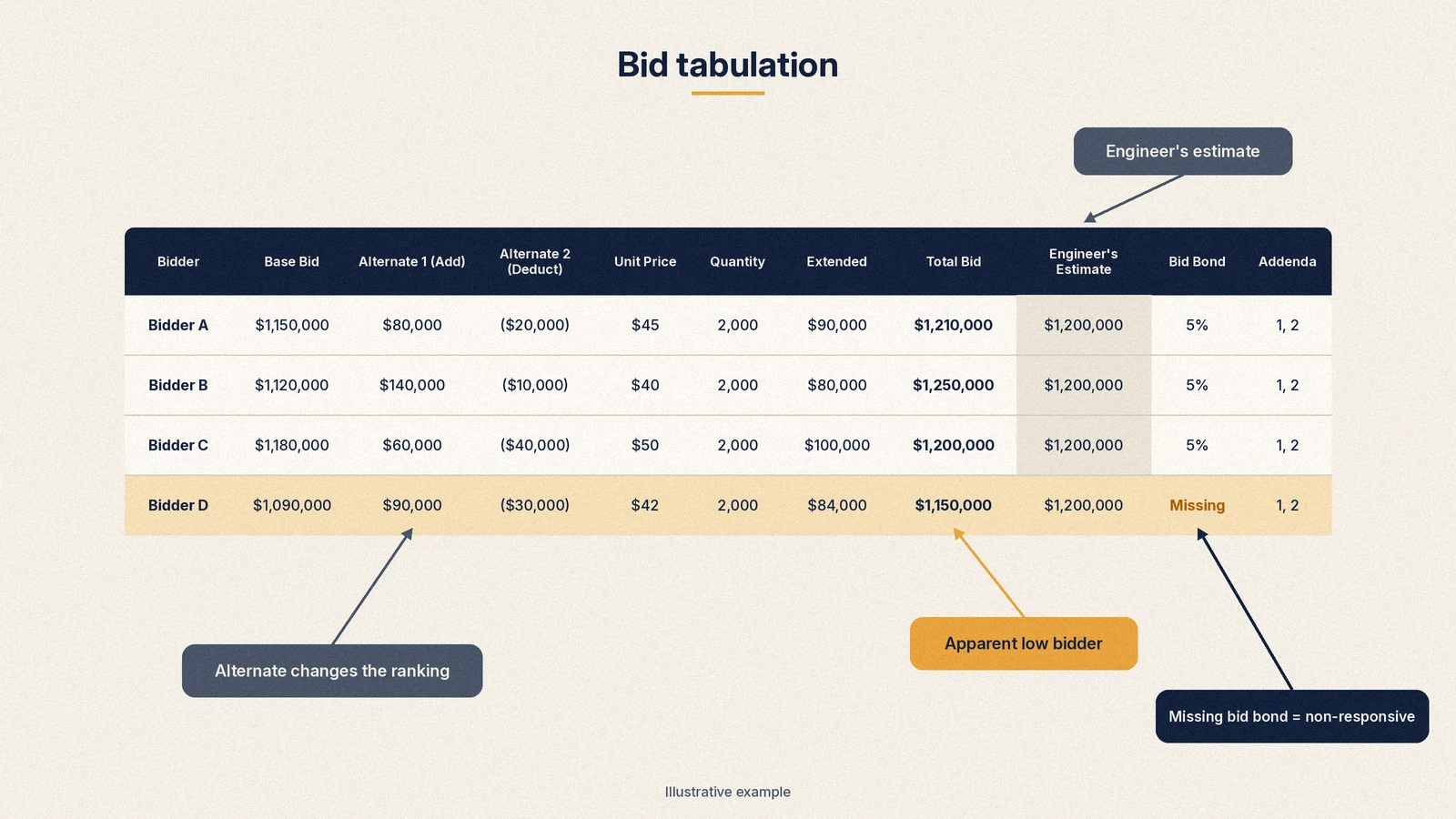
A bid tabulation is a table. Each bidder gets a row (or a column, depending on the agency). For each bidder it shows the total bid, and often the base bid, the alternates and every unit price. Construction agencies usually add the engineer's estimate too. WSDOT describes its tabs as a record of "the engineer's estimate and bid amount for each project, by bid item and contractor."
You will see several names for the same document:
- Bid tab, bid tabulation, bid tabulation sheet: the common state and local terms.
- Abstract of offers or bid abstract: the federal term, from FAR 14.403.
- Bid results or bid openings and results: common portal labels. Baton Rouge's open data portal uses that exact title.
- Certified tabulation: a tab the bid opening officer has checked for accuracy.
A tab is not an award. Most agencies post a tab soon after the opening, while the apparent low bidder's paperwork is still being checked. Award comes later. North Carolina's eVP separates the two stages clearly: a "Preliminary Bid Tabulation" includes "only the names of participating vendors," and a "Final Bid Tabulation" adds the prices. On some city pages the tab is the award record. Bucks County, Pennsylvania, for example, says its "Tabulations show the award made."
Bid tabs come from sealed bidding: invitations for bid (IFB or ITB), where price decides. RFPs are negotiated, and there may be no public opening at all. The agency scores proposals on technical approach, past performance and price. What you can learn afterward is narrower, as covered below.
The public bid opening: where results start
In federal sealed bidding, the opening itself is public. Under FAR 14.402-1, the bid opening officer must "personally and publicly open all bids received before that time," read them aloud "if practical," and have them recorded. Anyone can attend, including companies that did not bid.
State and local rules follow the same pattern. Chicago's Department of Procurement Services reads bids aloud in its Bid and Bond Room. Chicago's bid tab page says a tab is "normally" online "within 24 to 48 hours after a bid has been opened and read aloud." For a joint venture, Chicago will email the JV members' names and ownership shares on request.
If you care about a particular bid, go to the opening, in person or by video. You hear every price on the day, before any portal posts the tab, and you can note who showed up but did not bid.
Where federal bid results and contract awards are published
Federal results come out in stages. Each stage goes to a different place, on a different timeline.
| Stage | What becomes public | Where | Timing |
|---|---|---|---|
| Public bid opening (sealed bids) | Bidder names and prices, read aloud | The contracting office | At the opening (FAR 14.402-1) |
| Abstract of offers | Every bid, certified by the opening officer | Ask the contracting officer to inspect it | "As soon after bid opening as practicable" (FAR 14.403) |
| Notice to unsuccessful bidders | Written notice; low bidders who lost are told why | Sent to bidders | Within 3 days of award (FAR 14.409-1) |
| Postaward notice (negotiated) | Number of offers, awardee, items, quantities, unit prices | Sent to offerors in the competitive range | Within 3 days of award (FAR 15.503) |
| Award notice | Awardee, amount, award date | SAM.gov Contract Opportunities | Required for most awards over $25,000; within 60 days for trade-agreement buys (FAR 5.301) |
| Contract action report | Full award record: NAICS, PSC, value, period of performance, number of offers | SAM.gov contract data and USAspending | Most agencies within 3 business days; DoD and USACE on a 90-day delay |
Three things about this table have changed recently or are easy to miss.
FPDS.gov is gone as a search site. SAM.gov announced that the FPDS.gov ezSearch application was decommissioned on February 24, 2026, and that the FPDS ATOM feed would be retired later in fiscal 2026. Fpds.gov now redirects to SAM.gov, and sam.gov/fpds explains how to search contract award data there. Older guides that send you to FPDS ezSearch are out of date.
Defense data runs 90 days behind. USAspending's About the Data says procurement data for DoD and the U.S. Army Corps of Engineers "are published on a 90-day delay." DoD awards make up most of the federal awards RFPFinder holds (table below). So a search for a defense award made last month will often come up empty. For faster news on large defense awards, check the Pentagon's daily contract announcements at defense.gov.
The award notice is not the bid tab. A SAM.gov award notice names the winner and the amount. It does not list the losing bidders or their prices. For those, ask the contracting officer for the abstract of offers on a sealed bid. On a negotiated buy, read your postaward notice and request a debriefing.
Federal awards RFPFinder holds, by agency
As of 2026-10-07, RFPFinder holds 87,342 federal awards from USAspending, totaling about $295.8 billion. These are the top agencies:
| Agency | Awards | Total value |
|---|---|---|
| Department of Defense | 62,308 | $201.7 billion |
| Department of Health and Human Services | 2,544 | $26.7 billion |
| Department of Homeland Security | 1,963 | $13.2 billion |
| NASA | 799 | $12.0 billion |
| Department of Agriculture | 4,672 | $9.2 billion |
| Agency for International Development | 369 | $7.7 billion |
| General Services Administration | 1,213 | $5.9 billion |
| Department of the Interior | 3,638 | $5.5 billion |
| Department of Veterans Affairs | 3,171 | $3.5 billion |
| Department of Transportation | 826 | $2.6 billion |
DoD accounts for about 71 percent of these awards by count. That is why the 90-day delay matters so much in practice.
Where state and local bid results are published
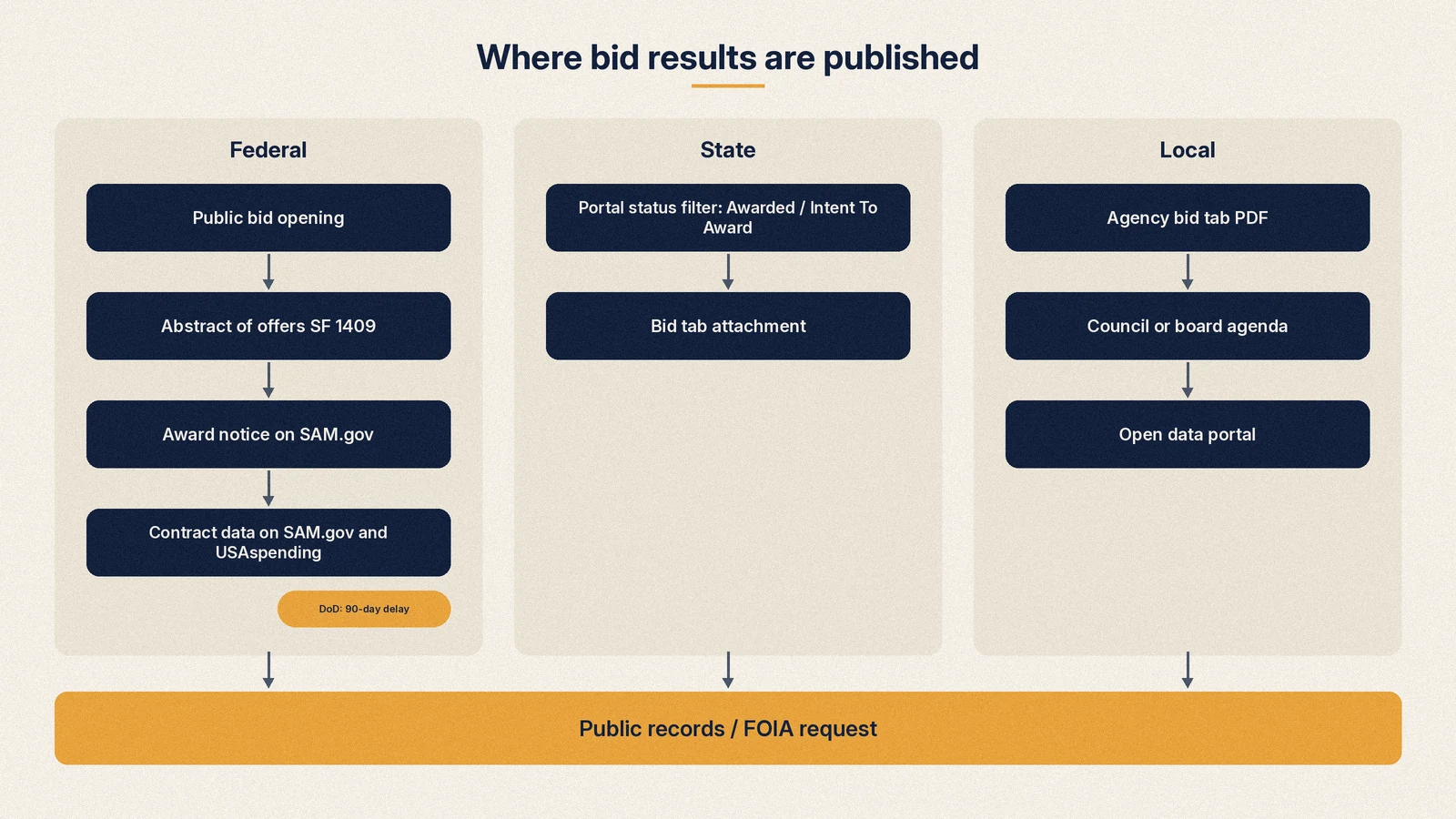
State and local results are spread across hundreds of systems. In practice you will find them in five kinds of places:
- The award or status filter on the state portal. On many portals, closed solicitations stay searchable and their status changes to awarded.
- Bid tab PDFs on the agency's website. Cities, counties, school districts and state DOTs post these, often one PDF per opening.
- Council, commission and school board agendas. Large awards need a vote, and the agenda packet often attaches the tab and the staff recommendation.
- Open data portals. A growing number of governments publish bid tabs and contract registers as downloadable datasets.
- Public records requests. When none of the above exists, you can still ask for the record.
State portals that show award status
We checked each portal's public search page on 2026-10-07 for award filters. Login information comes from RFPFinder's portal research.
| State | Portal | What you can see after the opening |
|---|---|---|
| Texas | ESBD | Status filter includes Awarded and No Award; a separate "Awards No Solicitation" type. Docs viewable without login |
| North Carolina | eVP | Awarded status filter. Posted tabulations and awards are "visible within that solicitation on the Public eVP" |
| Georgia | Georgia Procurement Registry | Status options include Awarded and Notice of Intent to Award |
| Arizona | Arizona Procurement Portal | "RFx Awarded" yes/no filter on public search |
| Massachusetts | COMMBUYS | Status filter: Opened, Evaluated, Intent To Award, Bid to PO, Closed |
| Illinois | BidBuy | Same status filter as COMMBUYS (same platform) |
| New Jersey | NJSTART | Same status filter, including Intent To Award |
| Oregon | OregonBuys | Same status filter, including Bid to PO |
| Nevada | NevadaEPro | Same status filter |
| Arkansas | ARBuy | Same status filter |
| Delaware | data.delaware.gov | "Proposals Received By Contract" dataset: total bids received, award date, number of awarded vendors |
| Hawaii | HIePRO | Portal FAQ says open solicitations and awards can be viewed without logging in |
On the Periscope-based portals (COMMBUYS, BidBuy, NJSTART, OregonBuys, NevadaEPro, ARBuy), two statuses are worth knowing. "Intent To Award" means a winner has been picked but the purchase order is not yet issued. "Bid to PO" means the order is out. Filter on either one with your commodity code and you get a list of who is winning in your category.
Local bid tabs and open data
Local governments publish more line-item pricing than most states do. These are good places to start:
| Source | What it publishes |
|---|---|
| TxDOT Bid Tabulations Dashboard | All bids on state and local lettings for the past 24 months, next to TxDOT's estimate |
| TxDOT bid tabs on data.texas.gov | Line items with quantity, bid unit price, engineer's estimate unit price and bid rank, as a download |
| WSDOT bid tabulations | Engineer's estimate and bids by item and contractor, by month or contract number |
| Cook County, IL bid tabulations | Bid opening date, contract number, number of responses, company, bid amount |
| Chicago bid tabs | Bids read at opening, normally online within 24 to 48 hours |
| Minneapolis bid tabulations | Every supplier that responded to an invitation to bid, with the prices submitted |
| Calvert County, MD bid results | Each solicitation's status, the bid tab and the awarded vendor with address |
| NYC Bid Tabulations (Historical) | Item-level bids by bidder; an archive last updated in 2023 |
How to find bid results for a specific solicitation
Here is the sequence that works most often, from fastest to slowest.
- Go back to the solicitation page. Note the solicitation number before the deadline. Most portals post the tab or award as an attachment or status change on the same record.
- Search the portal by status. Use the Awarded, Intent To Award or Bid to PO filter, or the closed-bids view, with the solicitation number or your commodity code.
- Check the agency's purchasing page for a "Bid Tabulations," "Bid Results" or "Awarded Contracts" link. City and county sites often keep these separate from the portal.
- Search board and council agendas for the solicitation number. The award item usually names the recommended vendor and the amount, and often attaches the tab.
- Search the open data portal for "bid tabulation," "contracts" or "procurement."
- For federal buys, look for the award notice on SAM.gov under the same solicitation number. Then search contract award data on SAM.gov or USAspending by agency, NAICS or PSC.
- Email the buyer named on the solicitation. FAR 14.409-1 says contracting officers "should make every effort" to give out the names of successful bidders and, if asked, the award prices. Many state and local buyers will simply send the tab.
- File a records request if all else fails (next section).
FOIA and public records requests for bid tabs and proposals
A public records request is the fallback. For sealed bid tabs it almost always works, because the prices were already read aloud in public.
Federal. Ask the contracting office first. The abstract of offers on an unclassified buy is already open to public inspection under FAR 14.403(b). If you have to use FOIA, agencies get 20 working days to decide on a request (5 U.S.C. 552(a)(6)). Keep the request narrow: name the solicitation number and ask for "the abstract of offers or bid tabulation and the executed contract." A narrow request comes back faster than one for "all records."
What you will not get. Competitive proposals are protected. Under 41 U.S.C. 4702 and FAR 24.202, a proposal "shall not be made available to any person under the Freedom of Information Act." The exception is a proposal that is "set forth or incorporated by reference in" the contract. FOIA exemption 4 also covers "trade secrets and commercial or financial information" that is privileged or confidential. So ask for the contract and its pricing schedule, not the winner's technical volume.
State and local. Every state has its own open records law, with its own deadlines and fees. Even TxDOT points people with data questions on its tab dashboard to an open records request. Two practical tips:
- Ask for the tab, the award recommendation memo and the executed contract with its price schedule. These are rarely withheld.
- Expect redactions in losing RFP responses. Many states let bidders mark pages as trade secret or confidential when they submit. Pricing pages in proposals may be redacted. Sealed bid prices usually are not.
How to read a bid tab
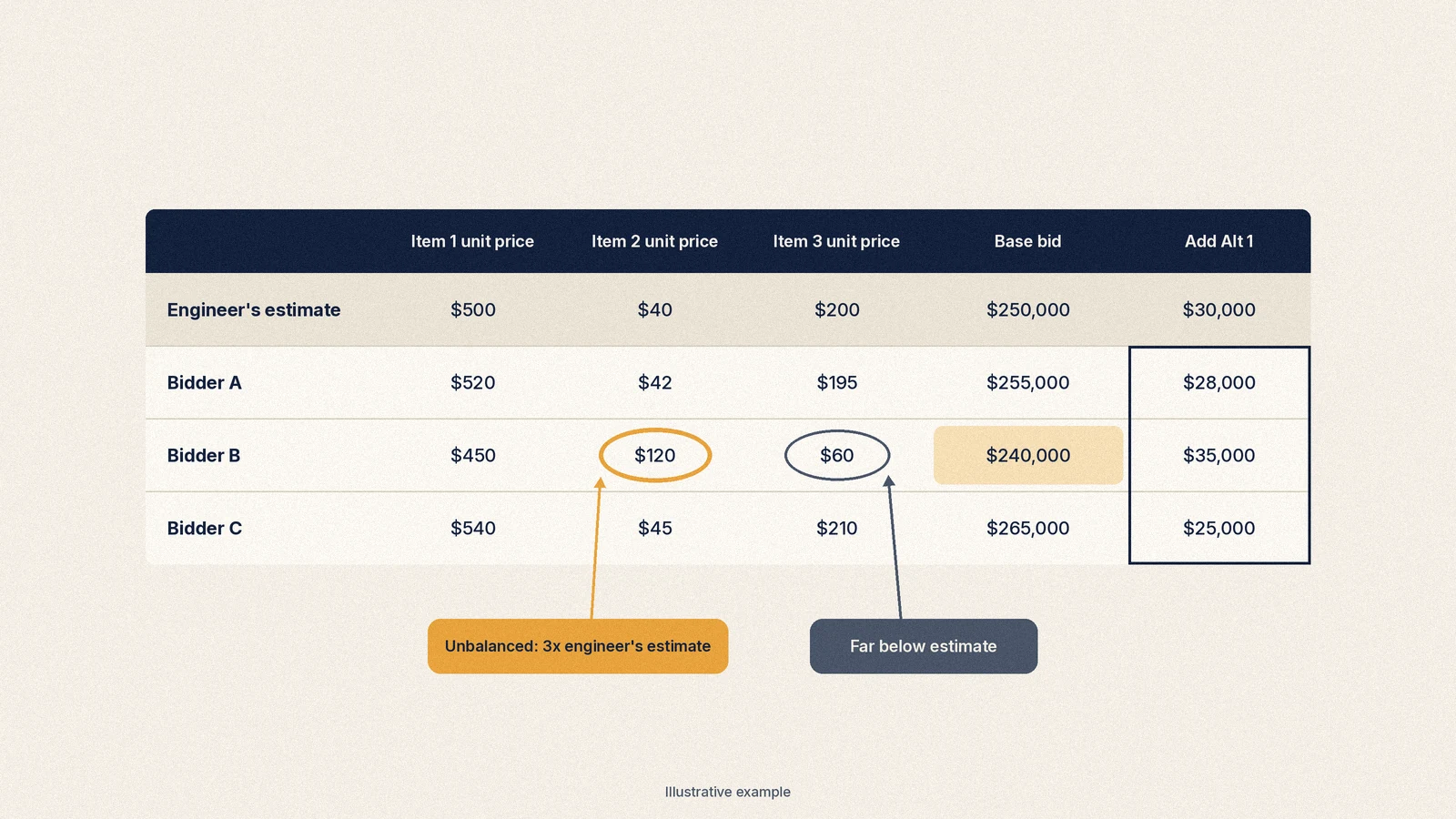
A tab only helps you if you read it the way the agency does. These are the columns that matter:
| Column | What it means | What to look for |
|---|---|---|
| Bidder | Firm or joint venture name | Name variants and JVs; the same firm can appear under several names |
| Base bid | Price for the core scope | The figure most agencies rank on |
| Alternates (add or deduct) | Priced options the agency may accept | Which alternates were taken can change the low bidder |
| Unit price and quantity | Price per unit times the estimated quantity | Extended totals that do not match; very low or very high single items |
| Engineer's estimate | The agency's own cost estimate | How far the bids landed above or below it |
| Total bid | Sum of the base bid and accepted alternates | The ranking figure |
| Bid bond, addenda acknowledged | Responsiveness checks | Missing items can disqualify the low bid |
| Notes or status | Non-responsive, withdrawn, apparent low | Why the low bidder was passed over |
Base bid and alternates. Many tabs rank on the base bid alone. Others rank on the base plus whichever alternates the agency accepts. Read the solicitation's basis-of-award clause before you decide who "won" a tab.
Unit prices. On unit-price contracts, quantities are estimates and the agency pays for actual quantities. A bidder can price an item it expects to overrun high and an item it expects to underrun low. That is called an unbalanced bid. On the tab it looks like one item far above the engineer's estimate and another far below.
Responsiveness and responsibility. Federal rules say a bid "must comply in all material respects with the invitation for bids" (FAR 14.301). Award goes to the "responsible bidder whose bid, conforming to the invitation, will be most advantageous to the Government, considering only price and the price-related factors" (FAR 14.408-1). Most state codes say the same thing as "lowest responsive and responsible bidder." Responsive means the bid followed the solicitation. Responsible means the company can actually do the work. When the low bidder on a tab does not win, one of these two tests is usually why.
Using bid tabs for pricing intelligence and recompete targeting
Bid tabs are the cheapest market research in public contracting. Here are four ways to use them.
Price your next bid. Pull every tab for your commodity or work type from one agency for the past two or three years. Line up the winning unit prices against the engineer's estimates. You get a price range for what that buyer actually pays, which is better information than any estimating rule of thumb.
Map your competitors. Count who bids, who wins and how wide the spread is between first and second place. A buyer where the same two firms trade wins at a narrow spread is a different market from one with eight bidders and a wide spread.
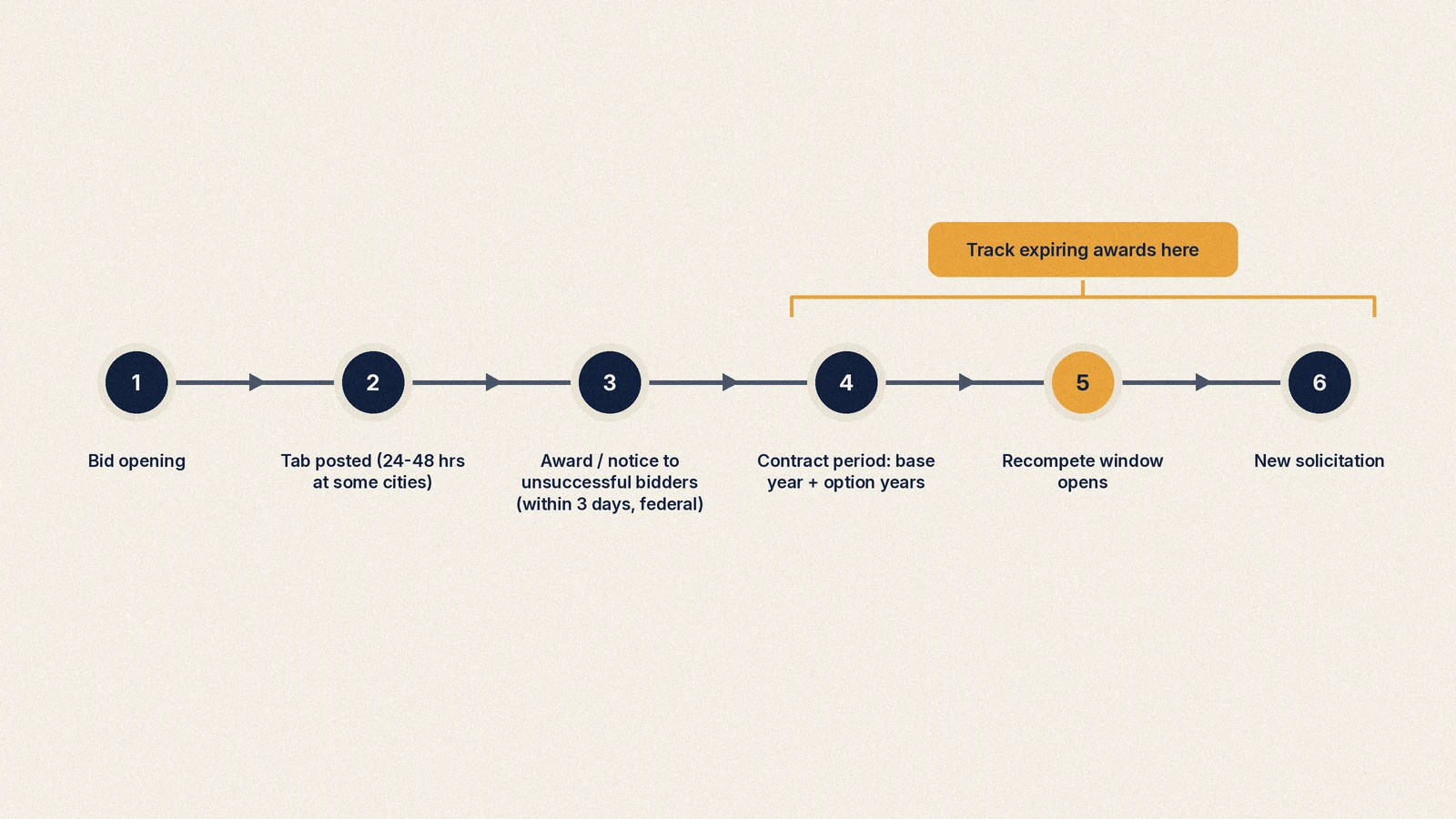
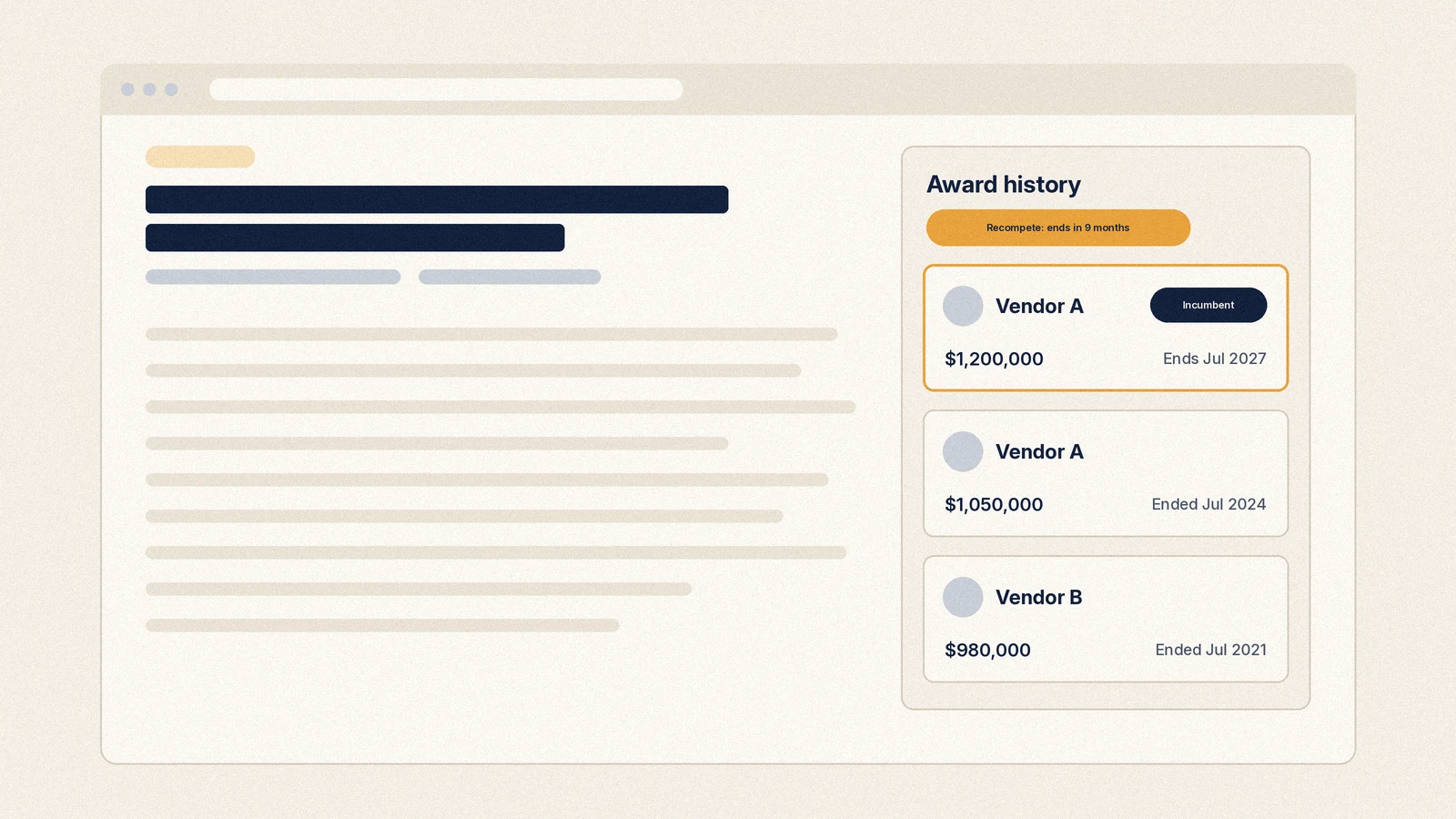
Spot recompetes early. Contract registers and federal award records carry an end date. Sort by end date and you have a list of contracts likely to be rebid, with the incumbent's name and price. In the federal data, read the period of performance and option years, not just the base period.
Decide whether to bid at all. If the incumbent has won the last several awards from the same office, it is worth asking what would change the outcome before you spend on a proposal.
Here is what this looks like across RFPFinder's data. As of 2026-10-07, RFPFinder found a named incumbent from USAspending on 1,249 open notices. On 749 open notices, one vendor won at least three of the office's last five awards in the same product or service code. On 4,144 notices, at least three different vendors split the last five awards. The resulting labels:
| Competition label on open notices | Notices |
|---|---|
| Competitive (several recent winners) | 3,039 |
| Incumbent (named incumbent, repeat winner or brand-name signs) | 1,846 |
| Sole source | 43 |
| Unknown (not enough award history) | 2,565 |
Limits of bid tabs and award data
Award data is useful, but it has gaps. Know them before you build a pricing model on it.
- Proposals are mostly closed. On RFPs you get the winner, the price and your own debriefing. You will not see competitors' technical approaches.
- Tabs are preliminary. Cook County calls its tabs "preliminary" and "for informational purposes only." TxDOT calls its dashboard "unofficial." Confirm the award before you quote a number.
- Debriefings have limits. A federal debriefing gives you the winner's overall evaluated price and technical rating. It cannot include "point-by-point comparisons" with other offerors or their cost breakdowns (FAR 15.506).
- Registers contain errors. In RFPFinder's state and local award data, one record has a phone number in the vendor field. Another carries a supplies contract total in the hundreds of billions of dollars, almost certainly a data-entry error. Check large or odd values against the source document.
- Names split. The federal top-vendor list shows "LOCKHEED MARTIN CORPORATION" (293 awards) and "LOCKHEED MARTIN CORP" (52 awards) as separate names. Use the UEI on federal records, and search several spellings on state and local ones.
- Coverage is uneven. Some agencies publish only PDFs, some only post an awarded status, and some publish nothing until someone asks.
Common mistakes
- Reading the apparent low bidder as the winner. The tab ranks bids. Responsiveness and responsibility checks come after.
- Missing the debriefing deadline. On negotiated federal buys, you must request a debriefing in writing "within 3 days after" you receive notice of award (FAR 15.506).
- Asking for proposals under FOIA. Ask for the contract and price schedule instead. Proposals are barred by statute unless they were written into the contract.
- Searching FPDS ezSearch. It was decommissioned in February 2026. Use SAM.gov contract data or USAspending.
- Concluding from a defense search that nobody won. DoD and USACE data runs 90 days behind.
- Comparing totals across different alternates. Check which alternates each total includes before comparing bidders.
- Skipping the opening. Attending, or watching online, gives you every price on the day.
What RFPFinder shows you
RFPFinder puts award history next to open bids, so you can check the incumbent before you decide whether to chase a bid.
- Federal awards: 87,342 awards from USAspending as of 2026-10-07, matched to open notices by office, PSC and NAICS. Each notice shows the incumbent and competition signals described above.
- State and local awards: 146,775 awards and purchase orders from government open-data registers in nine states:
| State | State and local awards held |
|---|---|
| New York | 49,134 |
| California | 27,301 |
| Oregon | 19,139 |
| Arizona | 16,686 |
| Illinois | 9,901 |
| Louisiana | 9,621 |
| Texas | 9,183 |
| Delaware | 5,781 |
| Missouri | 29 |
- Recompetes: 14,877 expiring awards worth about $78.3 billion combined. Browse them at /recompetes/, or limit the list to state and local contracts at /recompetes/?level=sled.
- Open bids: 9,682 open solicitations, including 5,876 federal, by state and NAICS code. See the full source list at /coverage/.
The free listing shows the most recent award for each open notice. Full award lists, incumbent names on recompetes and CSV export are part of the paid plans on /pricing/.
FAQ
What is a bid tabulation? A bid tabulation, or bid tab, is the agency's record of every bid received on a solicitation. It lists each bidder's prices and usually ranks them. Construction tabs often add unit prices and the engineer's estimate. Federal agencies call it the abstract of offers.
Is a bid tab the same as an award? No. A tab shows who bid and at what price, usually right after the opening. The apparent low bidder still has to pass responsiveness and responsibility checks, and larger awards may need a board or council vote. Check the award status, award notice or board minutes to confirm the winner.
How do I find out who won a government bid? Start with the solicitation page on the portal; most post the tab or award there. Then try the portal's awarded or closed filter, the agency's bid results page, and board agendas. For federal awards, check the SAM.gov award notice and the contract data on SAM.gov or USAspending.
Where do I find federal bid results now that FPDS is gone? FPDS.gov's ezSearch was decommissioned on February 24, 2026, and its public functions moved to SAM.gov. Search contract award data on SAM.gov or use USAspending.gov. For a sealed bid's full price list, ask the contracting officer for the abstract of offers.
What is an abstract of offers? It is the federal bid tab: Standard Form 1409, or Optional Form 1419 for construction. The bid opening officer completes and certifies it after the opening. Under FAR 14.403(b), abstracts for unclassified acquisitions must be available for public inspection.
Can I get a competitor's proposal through FOIA? Generally no. Federal law bars release of competitive proposals under FOIA unless the proposal is set forth or incorporated by reference in the contract. You can usually get the executed contract and its pricing. Trade secrets and confidential commercial information can also be withheld under FOIA exemption 4.
Why can't I find a recent Defense Department award? Procurement data for DoD and the U.S. Army Corps of Engineers is published on a 90-day delay. A defense award from last month may not yet appear on USAspending or in SAM.gov contract data. Check the solicitation's award notice, or the Pentagon's daily contract announcements for larger awards.
How can bid tabs help me win more contracts? Tabs show what a buyer actually pays, how many firms compete and how close the race was. Use the unit prices to set your own pricing, the bidder lists to size up competitors, and contract end dates to plan for recompetes before the next solicitation is posted.
Questions
What is a bid tabulation?
A bid tabulation, or bid tab, is the agency's record of every bid received on a solicitation. It lists each bidder's prices and usually ranks them. Construction tabs often add unit prices and the engineer's estimate. Federal agencies call it the abstract of offers.
Is a bid tab the same as an award?
No. A tab shows who bid and at what price, usually right after the opening. The apparent low bidder still has to pass responsiveness and responsibility checks, and larger awards may need a board or council vote. Check the award status, award notice or board minutes to confirm the winner.
How do I find out who won a government bid?
Start with the solicitation page on the portal; most post the tab or award there. Then try the portal's awarded or closed filter, the agency's bid results page, and board agendas. For federal awards, check the SAM.gov award notice and the contract data on SAM.gov or USAspending.
Where do I find federal bid results now that FPDS is gone?
FPDS.gov's ezSearch was decommissioned on February 24, 2026, and its public functions moved to SAM.gov. Search contract award data on SAM.gov or use USAspending.gov. For a sealed bid's full price list, ask the contracting officer for the abstract of offers.
What is an abstract of offers?
It is the federal bid tab: Standard Form 1409, or Optional Form 1419 for construction. The bid opening officer completes and certifies it after the opening. Under FAR 14.403(b), abstracts for unclassified acquisitions must be available for public inspection.
Can I get a competitor's proposal through FOIA?
Generally no. Federal law bars release of competitive proposals under FOIA unless the proposal is set forth or incorporated by reference in the contract. You can usually get the executed contract and its pricing. Trade secrets and confidential commercial information can also be withheld under FOIA exemption 4.
Why can't I find a recent Defense Department award?
Procurement data for DoD and the U.S. Army Corps of Engineers is published on a 90-day delay. A defense award from last month may not yet appear on USAspending or in SAM.gov contract data. Check the solicitation's award notice, or the Pentagon's daily contract announcements for larger awards.
How can bid tabs help me win more contracts?
Tabs show what a buyer actually pays, how many firms compete and how close the race was. Use the unit prices to set your own pricing, the bidder lists to size up competitors, and contract end dates to plan for recompetes before the next solicitation is posted.
Related guides
- How to find RFPs (and government contracts) without paying for a database8 min read
- Government contracts for small business: how to get started9 min read
- Set-aside certifications: 8(a), HUBZone, SDVOSB, WOSB7 min read
- RFP vs RFQ vs RFI (and IFB, sources sought and more)6 min read
- How to write an RFP response that gets scored9 min read
- CAGE code lookup, UEI lookup and DUNS: find, read and use all three IDs16 min read
- DIBBS explained: how DLA bids, automated awards and approved sources work17 min read
- DoD contracts: the buying commands, where they post, and how small firms win16 min read
- "GSA Schedule Contracts in 2026: What MAS Is, Who Should Apply, How Orders Flow"17 min read
- How to Bid on Government Contracts: From Zero to a Submitted Bid18 min read
- "SAM.gov Search: Every Filter, Notice Type and Alert, Explained for Vendors"17 min read
- Sources sought notices: the cheapest way to shape a federal contract16 min read