
A CAGE code lookup takes about a minute: open the free SAM.gov Entity Information search, type a company name, UEI or CAGE code, and open the record. For firms that are not registered in SAM.gov, use the DLA's CAGE Search and Inquiry tool. This guide covers all three identifiers you will run into (CAGE, UEI and DUNS), shows how to look each one up, and explains how to use a competitor's UEI to see the contracts it has won.
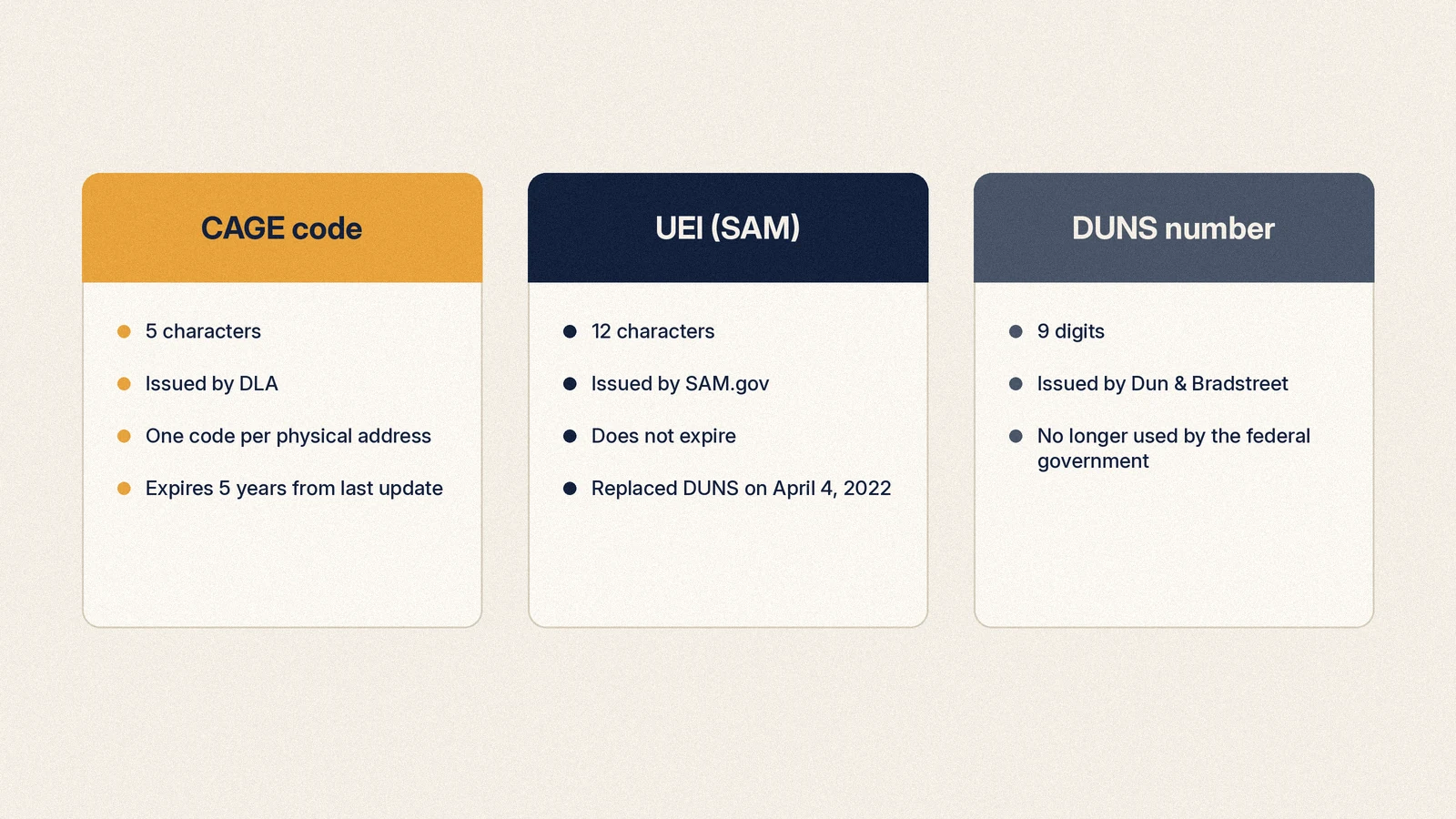
CAGE vs UEI vs DUNS at a glance
These are three different numbers from three different issuers, and they do three different jobs. GSA's Unique Entity ID FAQ puts it in one line: DUNS is issued by Dun and Bradstreet, the UEI by SAM.gov, and CAGE and NCAGE codes by DoD.
| CAGE code | UEI (SAM) | DUNS number | |
|---|---|---|---|
| Full name | Commercial and Government Entity code | Unique Entity ID (SAM) | Data Universal Numbering System |
| Issued by | DLA CAGE Branch (NATO or NSPA for foreign NCAGE) | SAM.gov (GSA) | Dun and Bradstreet |
| Format | 5 characters, letters and numbers | 12 characters, letters and numbers | 9 digits |
| Identifies | One legal entity at one physical address | One SAM registration or legal entity | One business location in D&B's file |
| Cost | Free | Free | Free from D&B |
| Expires? | Yes, five years from last update | No | No |
| Used by the federal government? | Yes, required before most awards | Yes, the authoritative ID since April 4, 2022 | No, removed from SAM.gov on April 4, 2022 |
| Where to look it up | SAM.gov, cage.dla.mil | SAM.gov, USAspending.gov | Dun and Bradstreet |
Sources: FAR 52.204-16, GSA UEI transition fact sheet, GSA UEI FAQ, Dun and Bradstreet, and the 2020 Office of Naval Research guide Contracting with the DoD.
What is a CAGE code?
A CAGE code is a five-character alphanumeric identifier for a business at a specific location. The Office of Naval Research's contracting guide describes it as a "five character alpha-numerical identifier" for entities in the United States and its territories. It shows up on contracts, in SAM.gov, in DLA's bid board, and on the technical data packages that tell you which manufacturer made a part.
The FAR makes it a hard requirement. Under FAR 4.1802, offerors must give the contracting officer the CAGE code for the location doing the work before award, whenever the contract is above the micro-purchase threshold and SAM registration is required. If another company owns or controls you, you must also give that parent's CAGE code and legal name.
Who issues it: the DLA CAGE program
The Defense Logistics Agency runs the CAGE program. FAR 52.204-16 defines a CAGE code as an identifier assigned to entities in the United States or its outlying areas by the DLA Commercial and Government Entity (CAGE) Branch. The public front end is cage.dla.mil, which hosts CAGE Search and Inquiry (CSI), the request and update forms, and news. The DoD-run Warfighting Acquisition University notes that CSI replaced the older BINCS system, so guides that still send you to BINCS are out of date.
If you are stuck, the DLA Customer Interaction Center, listed on cage.dla.mil, answers at 1-877-352-2255.
Format and what one record covers
A U.S. CAGE code is five characters long, made of letters and numbers. Two rules matter more than the format:
- One code per physical location. DoD's PGI 204.18 says CAGE codes "are assigned per legal entity at individual physical addresses" and are not assigned to mailing addresses. A company with three plants can have three CAGE codes under one parent.
- The parent counts. FAR 52.204-17 and FAR 4.1802(b) make you report your immediate owner and highest-level owner, by CAGE code, if you have them. That is how the government links subsidiaries to a parent.
The same five characters can also identify a parts maker on a drawing or a National Stock Number record. That is why bidders on DLA spare parts look up CAGE codes as often as they look up companies.
NCAGE codes for foreign firms
A business outside the United States gets an NCAGE (NATO Commercial and Government Entity) code instead. FAR 52.204-16 says foreign entities get one from their country's codification bureau if the country is a NATO member or sponsored nation, and otherwise from the NATO Support and Procurement Agency (NSPA). NSPA's request and search tool is the NCAGE Code Request Tool. The FAR text still lists the older NSPA address, eportal.nspa.nato.int/AC135Public/scage/CageList.aspx.
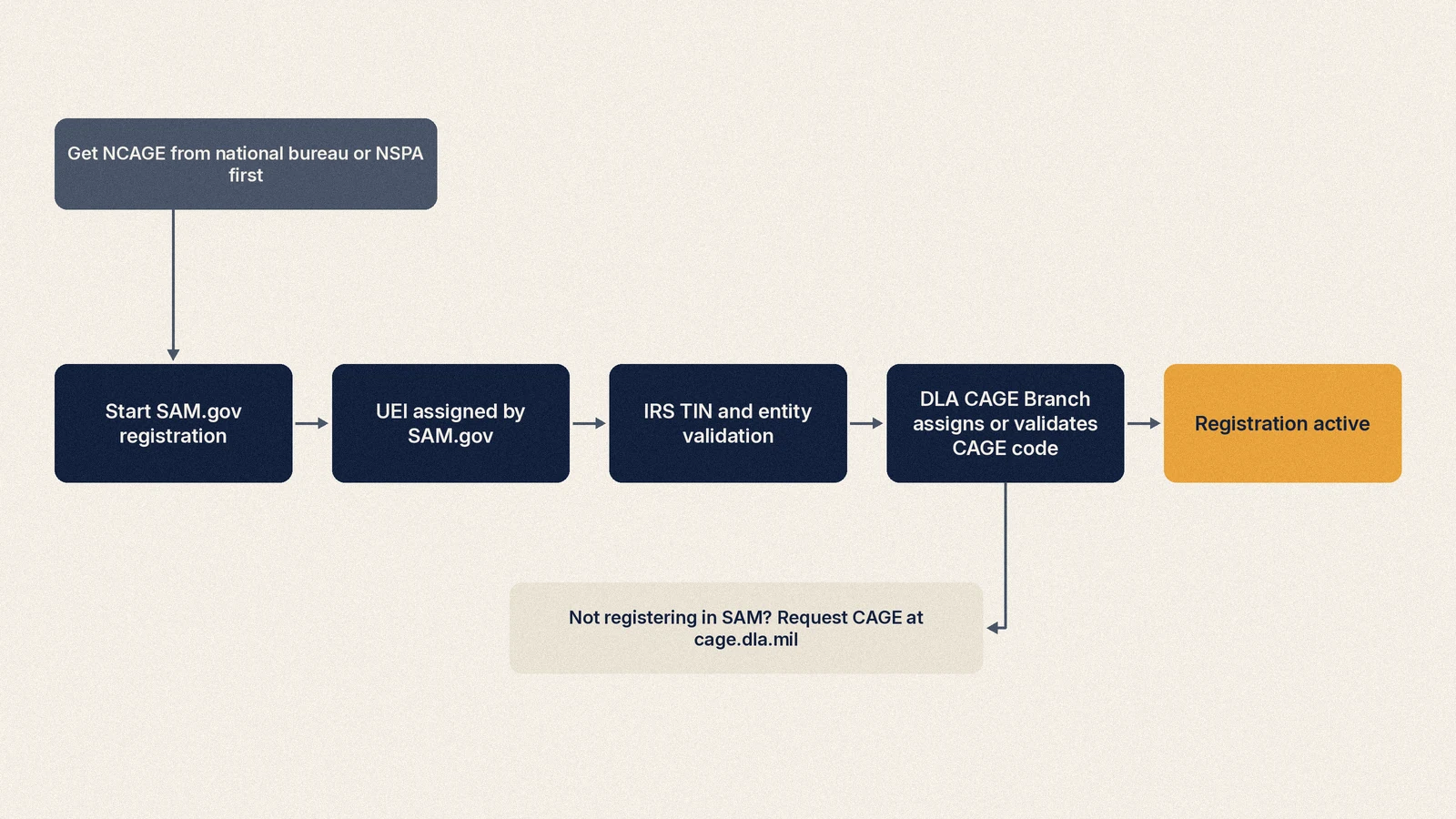
Order matters for foreign firms. The ONR guide lists the CAGE or NCAGE code as required data for registering in SAM, and DoD's PGI says SAM records sent for CAGE validation must include an NCAGE already in NSPA's database. Get the NCAGE first, then start SAM.
How a CAGE code is assigned, and how to get one
There are three routes, all listed in FAR 52.204-16:
- Register in SAM.gov. For U.S. entities, "the DLA Commercial and Government Entity (CAGE) Branch will assign a CAGE code as a part of the SAM registration process." You do not apply to DLA separately. If you already have a CAGE code, you enter it during registration.
- Request one directly from DLA. Entities that are not required to register in SAM, such as a manufacturer whose parts are sold through distributors, can request a code at cage.dla.mil. PGI 204.18 also lists the paper route, DD Form 2051.
- Foreign entities request an NCAGE code through their national bureau or NSPA, as above.
Track progress with the SAM.gov Entity Status Tracker, which accepts a UEI or CAGE code. SAM.gov registration is free. The ONR guide says plainly that SAM registration "is always free if you go directly to the government website." Firms that email you offering paid registration are selling help, not a different code.
How to do a CAGE code lookup, step by step
There are two official places to look up a CAGE code: SAM.gov and the DLA CAGE site. FAR 4.1803 tells contracting officers to verify a CAGE code by reviewing the entity's SAM registration, and to use cage.dla.mil for entities that are not in SAM. Use the same order yourself.
Method 1: SAM.gov Entity Information search (best for most lookups)
- Go to sam.gov/search/?index=ei. You do not need to sign in to see public registrations.
- Type the CAGE code, the 12-character UEI, or the company's legal name into the search box.
- Use the active-only filter if you only want current registrations. Turn it off to find expired ones, which matters when you are researching a competitor that let its registration lapse.
- Open the entity record. It shows the legal business name, UEI, CAGE code, physical address, registration status and expiration date.
- Scroll the record for business types, NAICS codes and any socioeconomic status the entity reports, such as SDVOSB or WOSB.
One limit: SAM.gov says that you "must sign in with your federal email address to view registrants who have opted out of public search." If a company you know is registered does not appear, it may have opted out, and the DLA site is your fallback.
Method 2: DLA CAGE Search and Inquiry (best for codes outside SAM)
- Go to cage.dla.mil. The site first shows a U.S. Government system-use notice, which you must accept to continue.
- Choose "CAGE Search and Inquiry" from the menu.
- Search by CAGE code or company name, and narrow by location if the name is common.
- Open the record to see the CAGE status, the entity's physical address and its other details.
CSI covers both domestic and foreign codes, and it includes entities that have never registered in SAM. That makes it the right tool when a drawing or parts listing shows a manufacturer's CAGE code and you need to know who that is.
Method 3: NCAGE lookup for foreign suppliers
Use the NSPA NCAGE tool to search NATO's database by name or code. NSPA's page says that if you do not find your organization, you can request a new NCAGE code from the same tool.
Reading the result
- Status. Check that the code is active. An obsolete, cancelled or expired code on a record you plan to team with is a red flag.
- Address. The CAGE code belongs to the physical address shown. If the work will be done somewhere else, that location may need its own code.
- Ownership. If the record names a parent CAGE code, look that one up too. Large primes often have dozens of location codes under one highest-level owner.
- Expiration. The SAM.gov registration expiration date tells you whether the company can receive a new award today.
UEI lookup: finding a Unique Entity ID
What the UEI is
The Unique Entity ID (SAM) is, in GSA's words, "a 12-character alphanumeric value managed, granted, and owned by the government." On April 4, 2022, SAM.gov and all other GSA systems switched to the UEI and stopped using the DUNS number. Every system in the Integrated Award Environment, including FPDS, CPARS, FAPIIS, eSRS and FSRS, now identifies entities by UEI.
A few facts from GSA's FAQ that most lookup pages leave out:
- It does not expire. "Once issued, the Unique Entity ID (SAM) will not expire." Your SAM registration still expires every year.
- It is not shared. Each SAM registration gets its own UEI, and a UEI is never shared across registrations.
- It is separate from CAGE. The UEI transition did not change CAGE codes. GSA's fact sheet says "CAGE code will NOT be affected by this transition."
- Name or address changes trigger re-validation. The UEI is tied to the SAM registration, so changing your legal name or address means the entity is validated again.
- It is built to avoid typos. The Federal Service Desk's quick start guide says the UEI leaves out the letters O and I so they are not confused with zero and one. If someone sends you a UEI containing an O, it is a typo.
How to look up your own UEI or someone else's
- Your own UEI: sign in to SAM.gov and open your entity workspace, or search your legal name on the public Entity Information search. If you once had a DUNS but never registered, you will not find a UEI under that DUNS, because SAM.gov removed the DUNS field.
- A competitor's or teaming partner's UEI: run the same public search by name or CAGE code. GSA's FAQ confirms you can always search by entity name or CAGE instead of the UEI.
- A subcontractor's UEI: ask them for it. GSA is explicit that a prime cannot request a UEI on a subawardee's behalf.
- Grant recipients: the UEI is also shown in your Grants.gov organization profile, according to the DOJ JustGrants guide to locating your UEI.
Getting a UEI without full registration
You can get a UEI without completing a full SAM registration. SAM.gov's entity registration page says you "can get a Unique Entity ID for your organization without having to complete a registration." This "UEI only" path suits subcontractors and grant subrecipients that need an ID for a prime's reporting but will not bid as a prime themselves. It does not give you a CAGE code or make you eligible for a direct federal award. For that you need the full registration.
DUNS lookup in 2026: what the DUNS number still does
"DUNS number lookup" still gets thousands of searches a month, but the federal answer is short. GSA's FAQ says the federal government "will have no requirement for the DUNS Number as of April 4, 2022," and after that date "the DUNS Number field will be blank (null) in all data extracts and APIs." You cannot search SAM.gov by DUNS, and a DUNS on a federal bid form is a sign the form template is out of date.
Dun and Bradstreet still issues and maintains DUNS numbers for commercial use. D&B describes it as "a unique nine-digit identifier used exclusively for businesses," says getting one is free, and offers a lookup tool on its D-U-N-S Number page. D&B also notes that "a D-U-N-S Number isn't required for U.S. federal government contracts," but that many other agencies, governments and companies still use it.
When you might still need a DUNS:
- A corporate prime's supplier portal or a credit check asks for one.
- A state, local or foreign buyer's vendor form still has a DUNS field. Check the solicitation. If it asks for a "unique entity identifier" and it is a federal or federally funded award, give the UEI.
- You are reading older award records. Datasets from before April 2022 may still carry a DUNS, so search by name or UEI to connect them to current records.
Federal contractor lookup: from a UEI to a competitor's award history
A CAGE or UEI lookup tells you who a company is. The next question is what it has won, and the UEI is the key that answers it. Names fail here. In RFPFinder's federal award data, the same company appears as "LOCKHEED MARTIN CORPORATION" on 293 awards and as "LOCKHEED MARTIN CORP" on 52 more. A name search for one misses the other. A UEI search does not.
USAspending.gov recipient profiles
- Go to USAspending.gov recipient search.
- Search the company name or paste the UEI.
- Open the recipient profile to see total obligations, top awarding agencies and the parent or child relationships between related entities.
- For contract-level detail, use Advanced Search, filter by recipient, and add an agency, NAICS or date filter. Export the results if you need to work in a spreadsheet.
SAM.gov contract data (formerly FPDS)
FPDS.gov now redirects to SAM.gov's contracting page, which says the FPDS ezSearch feature "has been retired and users should conduct all contract awards data searches in SAM.gov." Use the contract data domain of the SAM.gov search to see individual contract actions, including modifications, by UEI. Some vendors report needing a SAM.gov account to reach that data, so sign in if the search comes up empty.
What the biggest federal awardees look like
Here are the largest awardees in RFPFinder's federal award data as of 2026-10-07. Look up any of them on SAM.gov and you will usually find many CAGE codes and SAM registrations under one parent. The table shows why the UEI matters: the two Lockheed Martin rows are the same company.
| Awardee name as reported | Awards | Total value |
|---|---|---|
| LOCKHEED MARTIN CORPORATION | 293 | $48.25 billion |
| THE BOEING COMPANY | 859 | $13.59 billion |
| NORTHROP GRUMMAN SYSTEMS CORPORATION | 372 | $8.06 billion |
| RAYTHEON COMPANY | 218 | $7.45 billion |
| SPACE EXPLORATION TECHNOLOGIES CORP. | 11 | $4.51 billion |
| LOCKHEED MARTIN CORP | 52 | $4.28 billion |
| LEIDOS, INC. | 119 | $3.34 billion |
| UNITED CONCORDIA COMPANIES, INC. | 14 | $3.36 billion |
Source: RFPFinder award data from USAspending, as of 2026-10-07.
Where the awards come from
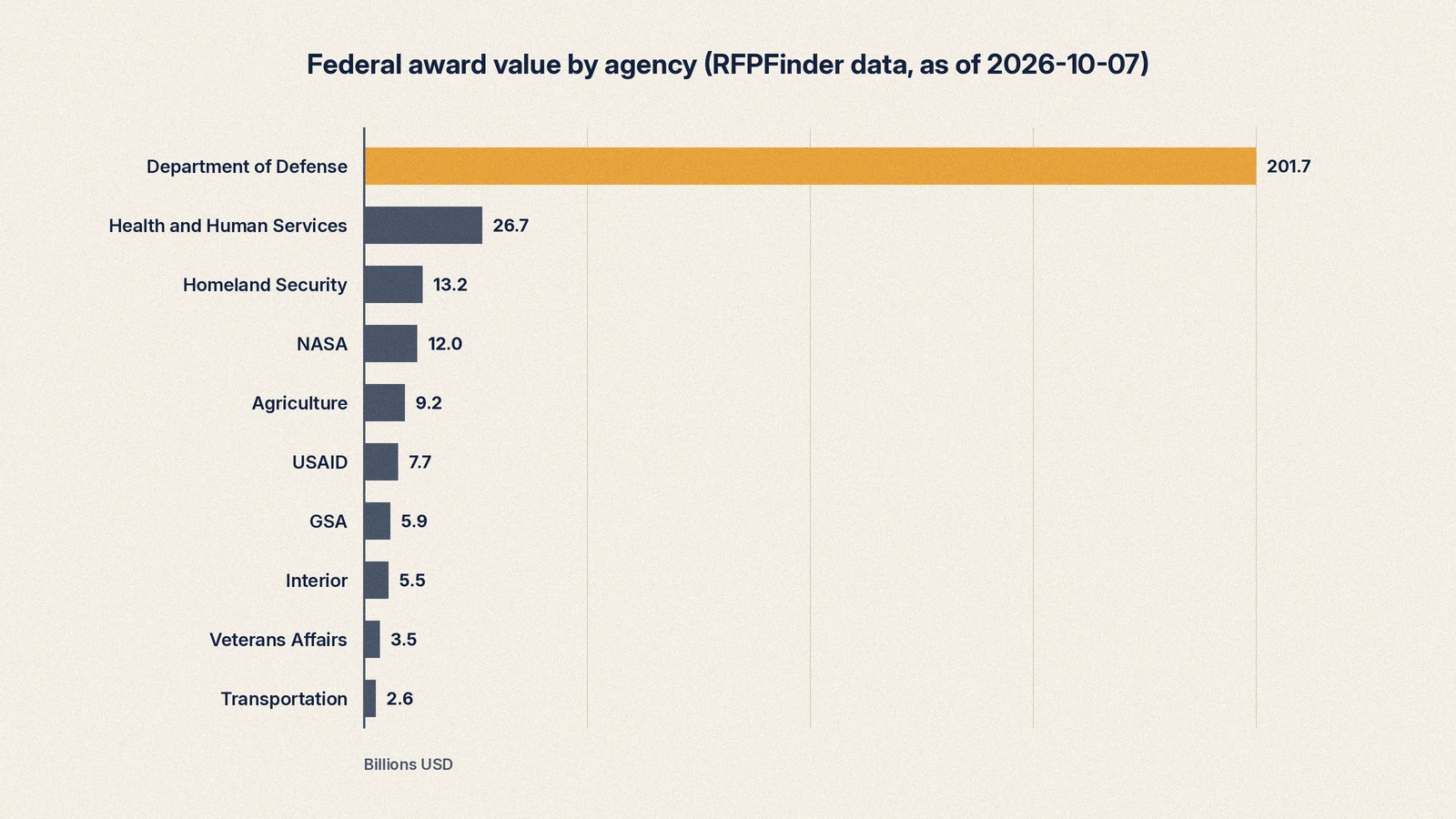
The same data shows why the CAGE code matters most to defense vendors. As of 2026-10-07, RFPFinder tracks 87,342 federal awards worth about $295.8 billion. The Department of Defense accounts for 62,308 of them (71%) and $201.7 billion of the value (68%). DLA's bid board, DoD's highest-volume buying channel in our open-notice data, will not let you register without one.
| Awarding agency | Awards | Total value |
|---|---|---|
| Department of Defense | 62,308 | $201.68 billion |
| Department of Health and Human Services | 2,544 | $26.73 billion |
| Department of Homeland Security | 1,963 | $13.20 billion |
| National Aeronautics and Space Administration | 799 | $12.00 billion |
| Department of Agriculture | 4,672 | $9.17 billion |
| Agency for International Development | 369 | $7.74 billion |
| General Services Administration | 1,213 | $5.92 billion |
| Department of the Interior | 3,638 | $5.54 billion |
| Department of Veterans Affairs | 3,171 | $3.55 billion |
| Department of Transportation | 826 | $2.56 billion |
Source: RFPFinder award data from USAspending, as of 2026-10-07. Top 10 agencies by total value.
Which identifier you need, and when
| Situation | What you need | Where it comes from |
|---|---|---|
| Bidding as a prime on a federal contract above the micro-purchase threshold | UEI, active SAM registration and CAGE code | SAM.gov registration (CAGE assigned by DLA during it) |
| Registering on DLA's bid board (DIBBS) | CAGE code from an active SAM registration | SAM.gov, then DIBBS |
| Subcontracting under a federal prime that reports subawards | UEI (UEI-only is fine) | SAM.gov "Get Unique Entity ID" |
| Applying for a federal grant | UEI and SAM registration | SAM.gov |
| Manufacturer whose parts are sold through distributors, not bidding directly | CAGE code | cage.dla.mil request or DD Form 2051 |
| Foreign company bidding on U.S. federal work | NCAGE code first, then UEI | National codification bureau or NSPA, then SAM.gov |
| Commercial credit check or a corporate supplier portal | DUNS number, if they ask | Dun and Bradstreet |
| State, county or city bid | Whatever that portal requires, usually its own vendor ID | The state or local portal; see state portals |
DLA is explicit about the bid board: vendors must be registered in SAM.gov and have received a CAGE code before starting DIBBS vendor registration. That matters because DLA is the largest single source of open federal notices. As of 2026-10-07, RFPFinder lists 3,105 open DLA notices, 2,556 of them from DIBBS, out of 5,876 open federal notices.
Common mistakes and errors
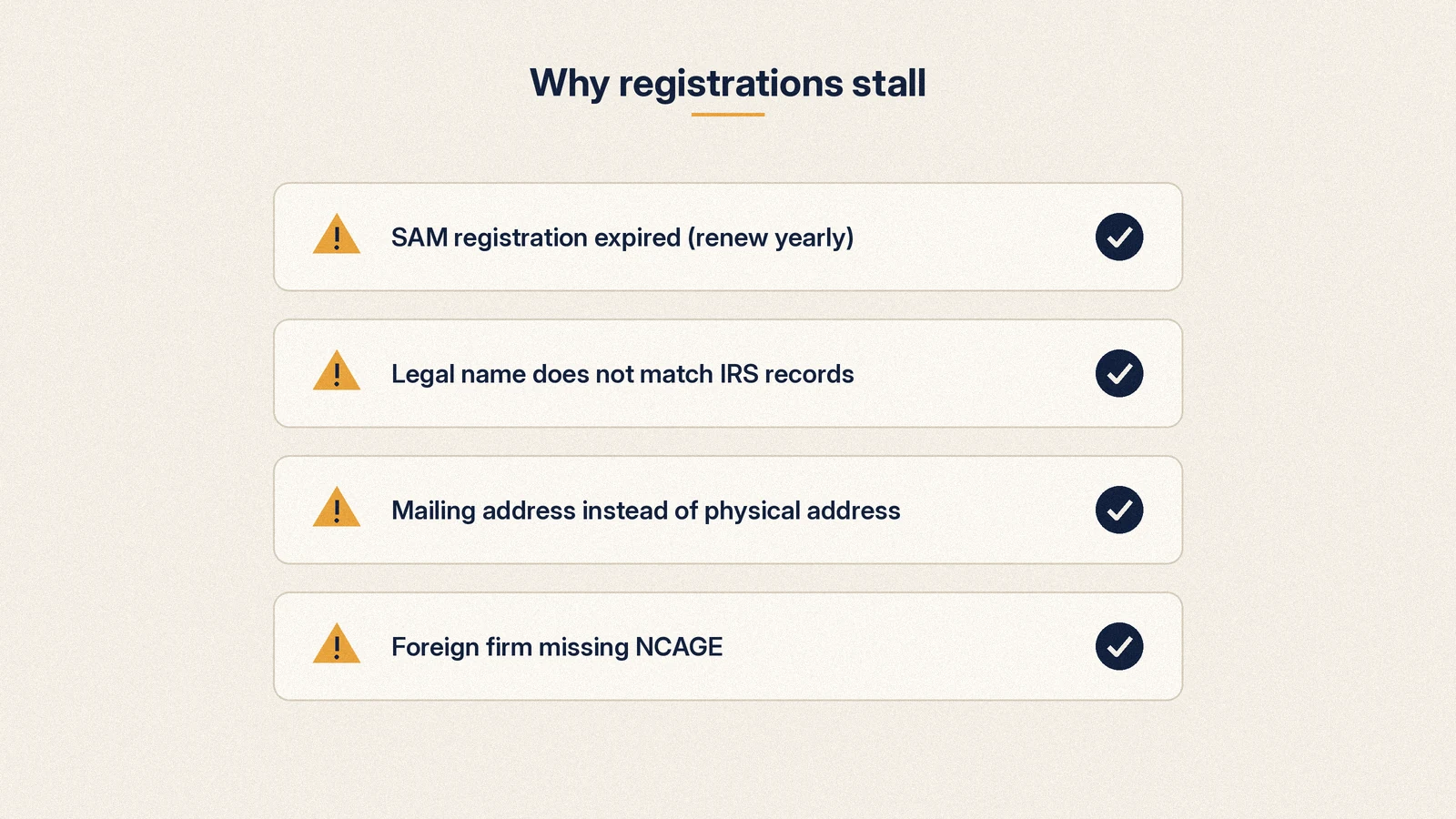
1. Letting the SAM registration expire. FAR 52.204-13 requires you to review and update your SAM information every year. An expired registration keeps your UEI and CAGE code but makes you ineligible for most new awards. Set a reminder 60 days before the expiration date shown on your SAM record.
2. Assuming your CAGE code is permanent. The 2020 ONR guide says CAGE codes "are given an expiration date of five years from the last update." Codes tied to an active SAM registration are refreshed through renewals. Standalone codes requested directly from DLA are the ones that quietly expire, so check them in CSI.
3. Name mismatches. Your SAM legal business name and physical address must match your IRS records and what the entity validation service has on file. A change of name or address triggers re-validation of the entity, and the registration can stall until the records agree. FAR 52.204-18 also requires you to tell the contracting officer about any CAGE code change within 30 days, so a reorganization can create contract paperwork too.
4. Using a mailing address. CAGE codes are tied to physical locations. PGI 204.18 says CAGE codes are not assigned to mailing addresses, so a P.O. box will not get you one.
5. Searching SAM.gov by DUNS. SAM.gov has had no DUNS field since April 2022. Search by name, UEI or CAGE instead.
6. Typing O for 0 or I for 1 in a UEI. The UEI never uses the letters O or I. If a lookup returns nothing, check for those first.
7. Trusting a name search to find all of a competitor's awards. Award data records the awardee name as each contracting office entered it. Search by UEI, then check the parent relationships on USAspending.
8. Starting SAM before the NCAGE (foreign firms). SAM validation needs an NCAGE that already exists in NSPA's database. Get it first.
9. Paying for something that is free. SAM registration, UEIs, CAGE codes and DUNS numbers cost nothing. Paid services sell help with the paperwork, not a different or faster code.
What RFPFinder shows you
Looking up a CAGE code or UEI is usually step one. Step two is finding work you can win and knowing who holds it now. That is what RFPFinder is built for.
- Awardees and UEIs on award data. As of 2026-10-07, RFPFinder tracks 87,342 federal awards from USAspending, worth about $295.8 billion. RFP pages list the buyer's past awards with the awardee name, and the Pro award export adds each awardee's UEI, so you can paste it straight into SAM.gov or USAspending. State and local award records in our data carry the vendor name only.
- Recompetes. The recompetes page lists federal contracts reaching the end of their period of performance in the next 6 to 24 months, filterable by NAICS, PSC and agency, with a state and local view too. As of 2026-10-07 it draws on 14,877 expiring contracts worth $78.3 billion. Pro shows the incumbent on every row, so you can look up its UEI and see the rest of its book.
- Open notices in one place. RFPFinder lists 9,682 open RFPs right now, including 5,876 federal notices from SAM.gov and DLA. Browse by category, NAICS code or state, and see which sources we cover on the coverage page.
- Set-aside filters. 49% (2,899 of 5,876) of open federal notices carry a set-aside. Your SAM record decides whether you can bid on them, so keep it current.
See what alerts and exports include on the pricing page.
Questions
How do I look up a CAGE code for free?
Use the Entity Information search on SAM.gov, which is free and needs no login for public records. Type the company name, UEI or CAGE code and filter to active registrations. For entities that are not registered in SAM, such as some manufacturers and foreign firms, use the DLA CAGE Search and Inquiry tool at cage.dla.mil. Paid lookup sites only repackage these two sources.
What is a CAGE code?
A CAGE (Commercial and Government Entity) code is a five-character alphanumeric identifier that the Defense Logistics Agency assigns to a business at a specific physical location. Federal contracting officers must have it before awarding most contracts above the micro-purchase threshold, under FAR 4.1802. Firms outside the United States get an NCAGE code from NATO instead.
Is a CAGE code the same as a UEI?
No. GSA says the Unique Entity ID and the CAGE code are separate identifiers. The UEI is a 12-character ID issued by SAM.gov to the legal entity, while the CAGE code is issued by DLA and is tied to a physical address. Most registered contractors have both, and both appear on the SAM.gov entity record.
How do I get a CAGE code?
Register your entity in SAM.gov. Under FAR 52.204-16, the DLA CAGE Branch assigns a CAGE code as part of that registration, and it costs nothing. Entities that do not need a SAM registration can request one directly at cage.dla.mil, and foreign entities request an NCAGE code from their national codification bureau or NSPA.
Do CAGE codes expire?
Yes. An Office of Naval Research contracting guide states that CAGE codes get an expiration date of five years from the last update, while NCAGE expirations do not currently apply. Codes tied to a SAM registration are refreshed when the registration is updated or renewed, so the practical risk is letting SAM lapse.
Can I still look up a DUNS number on SAM.gov?
No. Since April 4, 2022, the DUNS number has been removed from SAM.gov and GSA systems, and the DUNS field is blank in SAM data extracts. Search SAM.gov by company name, UEI or CAGE code instead. Dun and Bradstreet still runs its own DUNS lookup for commercial credit and supplier purposes.
Does a UEI expire?
No. GSA's Unique Entity ID FAQ says that once issued, the UEI does not expire. Your SAM registration does expire if you do not renew it every year, and an expired registration makes you ineligible for most new awards even though the UEI itself stays the same.
How can I see what contracts a company has won?
Copy the company's UEI from SAM.gov and search it on USAspending.gov, which shows a recipient profile with obligations by agency and year. SAM.gov's contract data search, which replaced FPDS ezSearch, lists individual contract actions. RFPFinder shows awardee names and UEIs on its award and recompete pages so you can see who holds work you might bid on.
Related guides
- How to find RFPs (and government contracts) without paying for a database8 min read
- Government contracts for small business: how to get started9 min read
- Set-aside certifications: 8(a), HUBZone, SDVOSB, WOSB7 min read
- RFP vs RFQ vs RFI (and IFB, sources sought and more)6 min read
- How to write an RFP response that gets scored9 min read
- Bid Tabulations and Bid Results: Who Bid, Who Won and at What Price17 min read
- DIBBS explained: how DLA bids, automated awards and approved sources work17 min read
- DoD contracts: the buying commands, where they post, and how small firms win16 min read
- "GSA Schedule Contracts in 2026: What MAS Is, Who Should Apply, How Orders Flow"17 min read
- How to Bid on Government Contracts: From Zero to a Submitted Bid18 min read
- "SAM.gov Search: Every Filter, Notice Type and Alert, Explained for Vendors"17 min read
- Sources sought notices: the cheapest way to shape a federal contract16 min read