
A GSA Schedule is a long-term, governmentwide contract, formally called the Multiple Award Schedule (MAS), that lets federal agencies and some state and local buyers order your commercial products or services at prices negotiated once with GSA. In 2026 there is one consolidated MAS with 12 large categories and 278 Special Item Numbers (SINs). Applying costs nothing in fees, but the Schedule only pays off if you can sell at least $100,000 through it in the first five years, because GSA now enforces that floor.
What a GSA Schedule is in 2026
GSA runs the Multiple Award Schedule program, also called the Federal Supply Schedule. "Multiple award" means GSA awards the same contract vehicle to many companies and does not cap the number of holders. Each award is an indefinite delivery, indefinite quantity (IDIQ) contract: GSA fixes your prices, terms and scope, but nobody commits to buy anything specific. Orders come later, one agency at a time.
The contract can last up to 20 years: a five-year base period, as Winvale describes it, plus options. Under GSAR 552.238-116, the government can extend the term by another five years, up to three times.
GSA used to run separate numbered schedules, such as Schedule 70 for IT and Schedule 84 for security. It has since consolidated them into a single MAS, so today you submit one offer to one solicitation and pick the SINs that match what you sell. If a buyer or older article says "Schedule 70", they mean what is now the Information Technology large category.
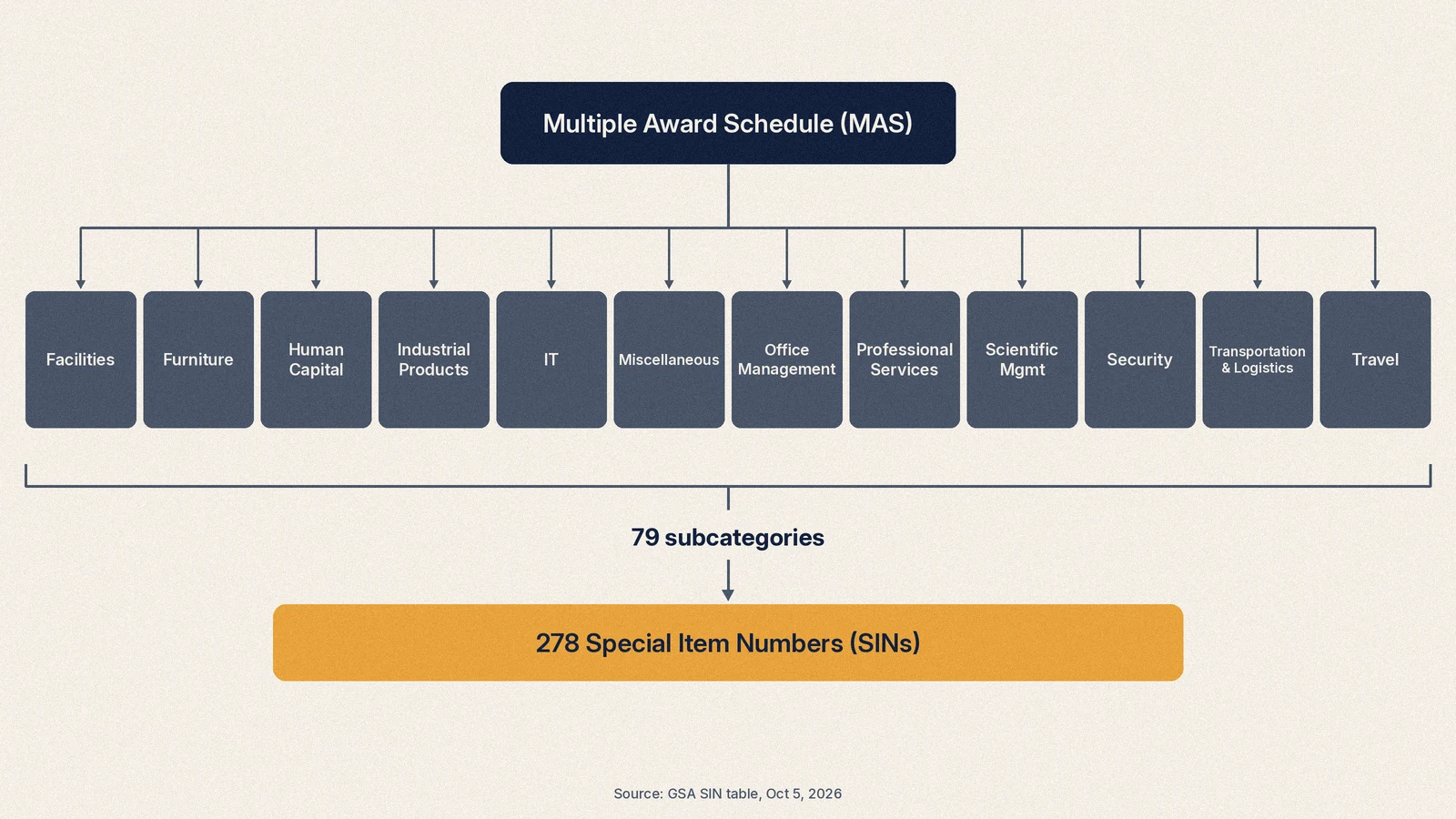
The 12 large categories and how many SINs each has
We counted the rows in GSA's live SIN look-up table on the MAS page. The right-hand columns map each category to the closest RFPFinder category, so you can see how much open-market work exists in the same space. The mapping is approximate because SINs and our categories are cut differently.
| MAS large category | Subcategories | SINs | Closest RFPFinder category | Open notices, all levels |
|---|---|---|---|---|
| Professional services | 10 | 42 | Consulting / Audit & Accounting / Marketing | 199 / 32 / 17 |
| Industrial products and services | 9 | 40 | Supplies & Equipment | 4,784 |
| Office management | 10 | 34 | Printing | 15 |
| Security and protection | 6 | 28 | Security | 29 |
| Facilities | 6 | 23 | Real Estate & Facilities / Janitorial / Landscaping | 142 / 119 / 107 |
| Furniture and furnishings | 9 | 22 | Supplies & Equipment | (shared) |
| Transportation and logistics | 4 | 22 | Transportation | 84 |
| Information technology | 9 | 21 | IT & Software | 207 |
| Scientific management and solutions | 6 | 15 | Supplies & Equipment (lab and test gear) | (shared) |
| Human capital | 4 | 14 | Staffing / Training | 45 / 47 |
| Miscellaneous | 3 | 11 | Other | 295 |
| Travel | 3 | 6 | No close match | n/a |
SIN counts: GSA SIN table, page last updated October 5, 2026. Open notice counts: RFPFinder, as of October 7, 2026.
Two things stand out. Professional services and industrial products have the most SINs, so most service and product firms will find a fit there. The Information Technology category has only 21 SINs, but they are broad. 54151S (IT professional services) covers almost any IT labor category, and 54151HACS (cybersecurity) and 518210C (cloud) are similarly wide.
Who can buy from a Schedule
Every federal executive agency can. State, local and tribal governments can buy only through four GSA programs listed on GSA's state and local page: Cooperative Purchasing (IT, security and law enforcement SINs), Disaster Purchasing, the 1122 program, and Public Health Emergencies. GSA publishes the SINs eligible for Cooperative Purchasing. If your SIN is not on that list, a city cannot use your Schedule for routine buying, no matter what a sales pitch says.
GSA Schedule vs open-market SAM.gov contracts
Most vendors meet federal buying through SAM.gov, where agencies post solicitations open to any registered business. A Schedule works differently. Here is how the two compare, with every rule taken from the FAR subpart 8.4 text effective March 13, 2026, or from GSA's pages.
| Question | GSA Schedule (MAS) order | Open-market SAM.gov solicitation |
|---|---|---|
| Who can compete | Only MAS holders with the right SIN | Any SAM-registered business that meets the terms |
| Where the requirement appears | GSA eBuy or a direct RFQ; FAR 8.404(a) says not to synopsize | SAM.gov Contract Opportunities |
| Pricing | Ceiling prices already found fair and reasonable; you can discount per order | Priced fresh in every proposal |
| Competition rules | FAR 8.405 ordering procedures, treated as full and open | FAR Parts 13, 14 or 15 |
| Small business set-asides | Optional, at the contracting officer's discretion (FAR 8.405-5) | Governed by FAR Part 19 set-aside rules |
| Response window | Set by the buyer, with no synopsis step | RFPFinder sees federal notices stay open an average of 30.8 days |
| Up-front investment | A full MAS offer and ongoing compliance | One proposal per opportunity |
The set-aside row matters for small firms. On the open market, FAR Part 19 set-aside rules apply, and right now 49% (2,899 of 5,876) of the open federal notices RFPFinder tracks carry a set-aside. Inside the Schedule, FAR 8.405-5 makes set-asides discretionary. GSA's roadmap notes that officers may set aside orders and BPAs when market research shows at least three capable firms.
Who should get a GSA Schedule, and who should not
GSA requires every offeror to take the Pathways to Success training (GSA estimates 3 to 4 hours) and to complete a Readiness Assessment, both within the past year. GSA says the assessment is meant to help you decide whether a MAS contract is the right choice for your business. Use the four tests below before you spend the hours.
Test 1: Two years of corporate experience
The standard MAS offer expects two years of corporate experience and two years of financial statements. GSA's Startup Springboard lets you substitute other evidence, such as key personnel experience, bank references, a line of credit or venture capital agreements. Many older guides miss the catch: GSA now limits Springboard to Information Technology category offers that qualify for FASt Lane and are agency-sponsored. A two-year-old janitorial or consulting firm with no track record will not get in that way.
Test 2: The $100,000 sales floor
GSA's post-award requirements checklist (updated September 23, 2026) says you must achieve $100,000 in sales within the first five years and $125,000 in each five-year period thereafter. It points to the cancellation clause, GSAR 552.238-79, which lets either party cancel on 30 days' written notice.
The often-quoted rule of "$25,000 in the first two years, then $25,000 a year" is the old standard. If an article still cites it, check how old it is before you trust anything else in it.
Startup Springboard awards carry the same floor. Ask yourself one question: can you name the agencies, SINs and contract vehicles that will produce $20,000 a year of Schedule orders? If not, a Schedule will sit idle and become a compliance liability.
Test 3: Your buyers actually use MAS
Some agencies buy what you sell through a Schedule; others use agency IDIQs, governmentwide acquisition contracts, or open-market buys. If current customers ask, "Are you on GSA?", that is the strongest signal you will get. If no one has asked, check where your target offices actually spend before you assume they use a Schedule.
Test 4: You can live with the economics
GSA negotiates against the pricing you give your most favored commercial customer. Unless your SINs use Transactional Data Reporting, the Price Reductions clause (GSAR 552.238-81) ties your Schedule price to that relationship. You will also pay the 0.75% Industrial Funding Fee on every sale and keep your Schedule prices in line with your commercial pricing for the life of the contract. Firms with volatile pricing or thin margins feel this most.
Who should pursue a Schedule: established product resellers and manufacturers with Trade Agreements Act compliant goods, IT and professional services firms with federal references, and companies whose customers already ask for a Schedule contract number.
Who should wait: firms under two years old outside IT, firms with no government past performance, and firms whose work is mostly construction. The MAS has some facilities and repair SINs, but new construction is generally solicited on SAM.gov under FAR Part 36. As of October 7, 2026, RFPFinder lists 1,326 open construction notices across all levels.
What it costs and how long it takes
GSA charges no application fee. The costs are your team's time, optional outside help, and the fee on sales after award.
| Item | What we could verify | Source |
|---|---|---|
| Filing fee | None appears anywhere on GSA's roadmap | GSA roadmap |
| Pathways to Success training | 3 to 4 hours, within the past year | GSA roadmap |
| SAM.gov registration | Allow up to 10 business days to become active | GSA: register your business |
| In-house offer preparation | 160 to 300 hours without a consultant (consultant estimate) | Federal Schedules, Inc. |
| Consultant fees | "a few thousand dollars to $10,000 or more" (consultant estimate) | GovPath Strategies |
| GSA review time | GSA publishes no standard; one consultant cites about three months for IT and up to a year for facilities or professional services | Winvale |
| Industrial Funding Fee | 0.75% of reported sales unless the solicitation says otherwise | GSA Vendor Support Center |
Plan on two clocks. The first is preparation: training, the Readiness Assessment, registrations, commercial sales documentation, past performance questionnaires, and the pricing file. The second is review: a contracting officer may ask for clarifications, run a financial review, then negotiate discounts before you sign a final proposal revision. Incomplete offers restart parts of that loop, which is why consultants' estimates vary so widely.
The fee is easy to underestimate. Under GSAR 552.238-80, the sales you report include the IFF, and GSA can change the rate, but not more than once a year. In practice, a $100,000 order includes $750 that you pass back to GSA. Price it in from day one.
How to get on the GSA Schedule, step by step
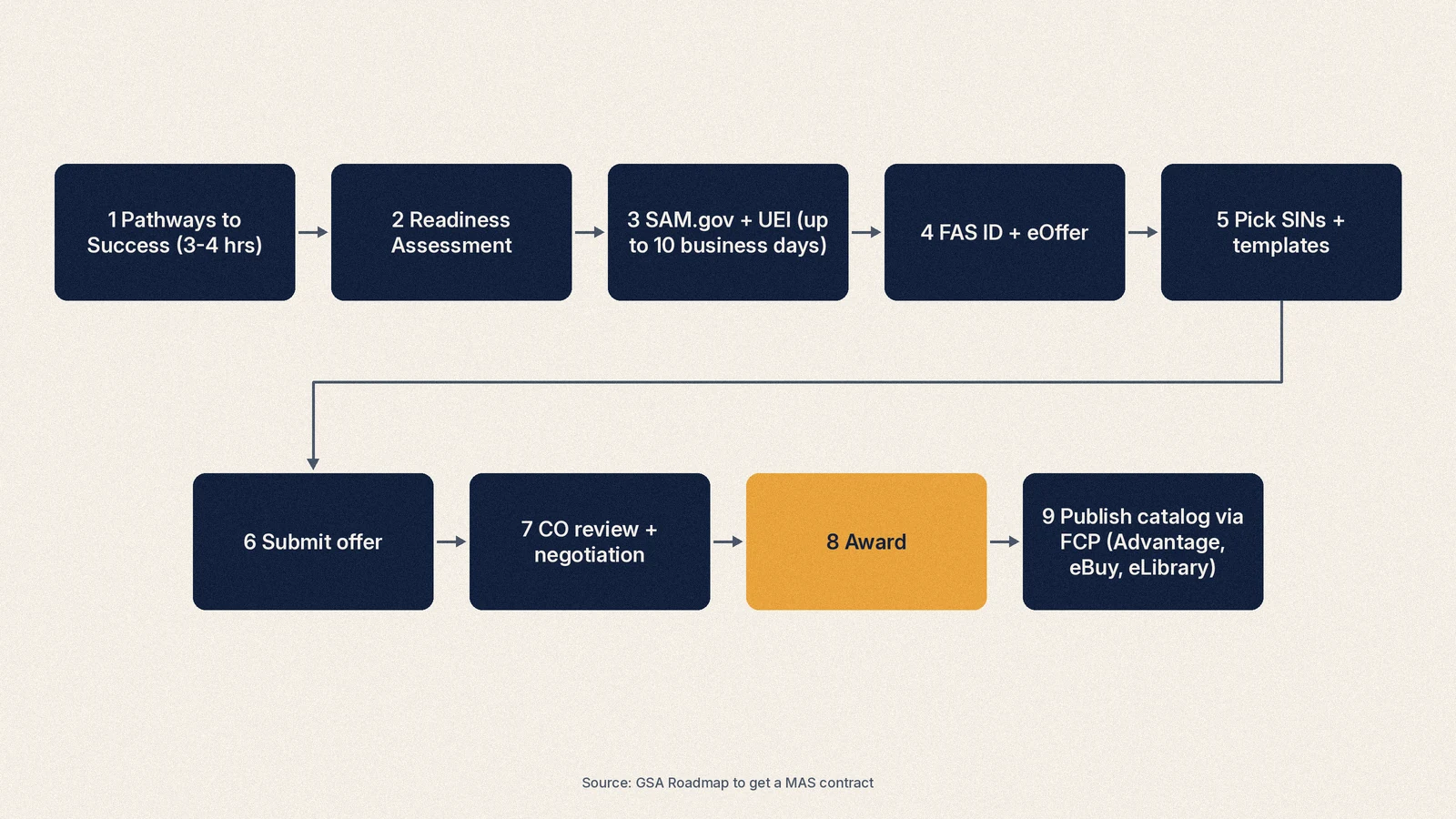
This sequence follows GSA's Roadmap to get a MAS contract, last updated April 2, 2026.
- Take Pathways to Success. It is mandatory, and you acknowledge it in eOffer.
- Complete the Readiness Assessment. An Authorized Negotiator who is a company employee must do it, not your consultant.
- Register in SAM.gov and get a UEI. The Unique Entity ID assigned in SAM.gov replaced the DUNS number, so ignore guides that still ask for a DUNS. Have your TIN, CAGE code, banking details and NAICS codes ready.
- Get a FAS ID for eOffer. You must be listed in SAM as a government business POC, electronic business POC or past performance POC (or an alternate) to get one.
- Pick your SINs. Use the SIN table on the MAS page and read each SIN's specific requirements. Offer only what you have sold commercially and can document.
- Read the whole solicitation and your category attachments. Then work through GSA's new offeror checklist. The current version is labeled Refresh 33 and dated September 25, 2026.
- Build the required templates. These include the pricing terms file, the FCP product or services price file, past performance questionnaires, and, for resellers, a letter of supply from each manufacturer. They are listed on GSA's required templates page.
- Check Trade Agreements Act compliance for every product, under FAR 52.225-5.
- Submit in eOffer, then answer clarifications fast. Negotiation centers on your discount from commercial pricing and your most favored customer.
- After award, publish your catalog. You register with the Vendor Support Center and publish through the FAS Catalog Platform. Until your catalog is live on GSA Advantage, eBuy and eLibrary, no buyer can find you.
How Schedule orders flow: eBuy, GSA Advantage and BPAs
Winning the Schedule gets you no orders. Orders come through three channels.
GSA Advantage is GSA's online catalog. FAR 8.402 describes it as the shopping service where buyers search by part number or common name and order directly, often with a government purchase card. Commodity products often sell here, on price and delivery.
GSA eBuy is GSA's electronic RFQ system. Buyers post a requirement, and Schedule holders on the matching SIN quote. Services, solutions and larger product buys often run through eBuy. Searches for "GSA bids" usually mean this system, and it sits behind a login, so only buyers and Schedule holders can use it.
Blanket Purchase Agreements (BPAs) are standing arrangements an agency sets up with one or more Schedule holders for repeat needs. Once a BPA is in place, orders flow to the BPA holders, not to the whole Schedule.
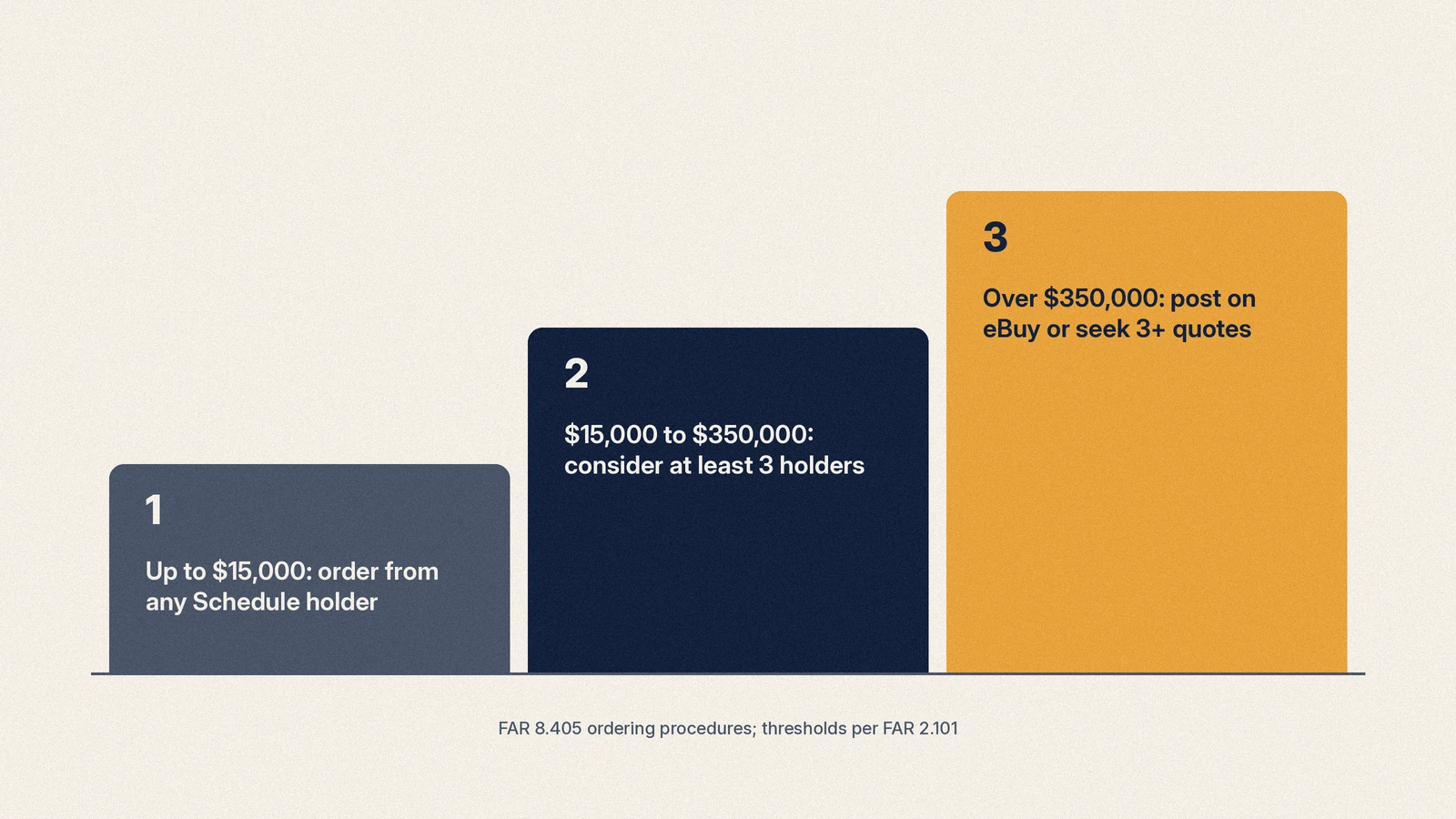
How widely a buyer must compete depends on the order's size. FAR 2.101 currently sets the micro-purchase threshold at $15,000 and the simplified acquisition threshold at $350,000.
| Order size | What FAR 8.405 requires of the buyer | What it means for you |
|---|---|---|
| Up to $15,000 | May order from any Schedule holder that meets the need, and should spread orders around | Your Advantage listing and relationships win these |
| $15,000 to $350,000 | Survey at least three Schedule holders (Advantage, price lists or quotes); for services, send the RFQ to at least three | You must be findable and on the buyer's short list |
| Above $350,000 | Post on eBuy to all holders of the SIN, or send to as many as practicable to get at least three quotes | Watch eBuy daily; this is where open competition happens |
The middle tier is where small firms lose quietly. A buyer can meet the three-quote rule without ever posting publicly, so if you are not one of the three firms the buyer knows, you never see the requirement. Marketing to contracting officers and program offices is part of the job.
Life after award: the compliance calendar
GSA assigns an Industrial Operations Analyst to review your compliance. These are the obligations most likely to trip up a new holder, all from GSA's post-award checklist.
| Obligation | Deadline | Clause |
|---|---|---|
| Post contract price list and Terms and Conditions file | 30 calendar days after award | I-FSS-600 |
| Register a FAS ID for the Sales Reporting Portal | 15 days before the first reporting period ends | GSAR 552.238-80 |
| Report sales by SIN and remit the IFF | 30 days after each quarter (or month, for TDR contracts) | GSAR 552.238-80 |
| Report price reductions to your contracting officer | 15 days after the reduction takes effect | GSAR 552.238-81 |
| Accept or return purchase card orders | Within 24 hours | GSAR 552.238-113 |
| Return orders from outside the federal executive branch you will not fill | Within 5 working days | GSAR 552.238-113 |
| Update your Advantage catalog after a modification | 30 days | GSAR 552.238-82 |
| Respond to the option notification letter in eMod | 165 days before contract end | GSAR 552.238-116 |
| Renew SAM.gov registration | Annually | FAR 52.204-7 |
| Hit the sales floor | $100,000 in years 1 to 5, $125,000 per later 5-year period | GSA checklist |
One rule surprises new holders. You must accept every order from a federal executive branch buyer that falls between your contract's minimum and maximum order limits. You cannot cherry-pick federal orders the way you can on the open market.
How to read a Schedule-related notice on SAM.gov
Because FAR 8.404(a) tells ordering offices not to synopsize Schedule orders, most MAS competition never reaches SAM.gov. Some of it does, and it is worth recognizing these notices so you don't waste a bid or miss a signal.
Schedule-only RFQs posted for visibility. Some agencies post a Schedule RFQ on SAM.gov for visibility. The giveaways are a reference to FAR subpart 8.4 or FAR 8.405, a named SIN (for example 54151S or 561210FAC), and an instruction to quote your GSA contract number. If you don't hold that SIN, you cannot win, even if the work fits you perfectly. Note the agency and SIN for future planning.
Sources sought notices that ask for your contract vehicle. When a sources sought notice asks respondents to list their GSA Schedule contract number and SIN, or other contract vehicles, the agency is deciding whether to buy through the Schedule or on the open market. As of October 7, 2026, RFPFinder tracks 698 open sources sought notices. Responding as a non-holder can still influence whether the buy goes to the open market or to a small business set-aside.
Limited-source justifications. For a Schedule order or BPA above $350,000 placed without full competition among holders, FAR 8.405-6 requires the agency to post a notice and the justification on SAM.gov within 14 days, for at least 30 days. These are after-the-fact, but they tell you who won and when the work may come back.
Award notices for BPAs and orders. These name the incumbent and the term. Feed them into your recompete calendar.
Notices that mention GSA but are not Schedule buys. GSA is also a buying agency in its own right. Its Public Buildings Service posts construction, lease and facilities solicitations on SAM.gov, open to any registered firm that meets the terms. As of October 7, 2026, RFPFinder shows 55 open notices from the Public Buildings Service. You don't need a Schedule to bid those.

Where GSA contracts fit in federal spending
People searching "GSA contracts" often assume GSA is where most federal money flows. Our award data says otherwise. RFPFinder holds 87,342 federal awards from USAspending totaling about $295.8 billion. Here are the top awarding agencies.
| Awarding agency | Awards | Total value |
|---|---|---|
| Department of Defense | 62,308 | $201.7 billion |
| Health and Human Services | 2,544 | $26.7 billion |
| Homeland Security | 1,963 | $13.2 billion |
| NASA | 799 | $12.0 billion |
| Agriculture | 4,672 | $9.2 billion |
| USAID | 369 | $7.7 billion |
| General Services Administration | 1,213 | $5.9 billion |
| Interior | 3,638 | $5.5 billion |
| Veterans Affairs | 3,171 | $3.5 billion |
Source: RFPFinder award data, as of October 7, 2026.
Two cautions. First, this table counts awards where GSA is the awarding agency, which includes Public Buildings Service construction and leasing, not all Schedule sales. Schedule orders placed by other agencies are credited to those agencies. Second, the biggest dollars in our data go to defense and aerospace primes. The top federal vendors in our data are Lockheed Martin ($48.2 billion), Boeing ($13.6 billion), Northrop Grumman ($8.1 billion) and Raytheon ($7.5 billion).
Open notices tell the same story. Of the 9,682 open notices RFPFinder tracks, 5,876 are federal. The busiest federal posters are the Defense Logistics Agency (3,105), the Navy (1,211), the Army (425), Veterans Affairs (199) and the Air Force (183). Of the DLA notices, 2,556 are DIBBS spare-parts solicitations, and none of that work requires a Schedule. For many small firms, the better first step is to win open-market work, build past performance, and add a Schedule once buyers start asking for one.
For Schedule-level sales data by SIN, GSA publishes the Schedule Sales Query Plus (SSQ+) dashboard. Use it to check whether your SINs actually move money before you apply.
Common mistakes
- Treating the award as revenue. A Schedule only lets you compete for orders. Holders who don't market it risk missing the $100,000 floor and losing the contract at option time.
- Planning around the old $25,000 rule. The current floor is $100,000 over the first five years and $125,000 per later five-year period.
- Assuming Startup Springboard covers you. It is limited to FASt Lane IT category offers that are agency-sponsored.
- Picking too many SINs. Every SIN needs commercial sales support and adds compliance work. Start with the two or three your past performance proves.
- Forgetting the IFF in your price. The 0.75% comes out of your margin if you price without it.
- Letting your most favored customer pricing drift. A bigger discount to your basis-of-award customer can trigger the Price Reductions clause, with 15 days to report it.
- Ignoring mass modifications. Each solicitation refresh brings a mass mod to accept. An unsigned one leaves your contract out of sync with the current terms.
- Quoting a Schedule-only RFQ without the SIN. If the notice cites FAR 8.4 and names a SIN you don't hold, your quote cannot be accepted.
- Abandoning the open market. RFPFinder currently tracks 5,876 open federal notices, and none of them requires a Schedule contract.
What RFPFinder shows you
RFPFinder covers the part of federal and public buying that is visible: SAM.gov notices, state portals, counties, cities, school districts and universities. It does not show GSA eBuy RFQs, which only Schedule holders can see. Here is how it helps on either side of the Schedule decision.
- Before you apply: browse open RFPs by category to see how much open-market work exists in your field. IT & Software and Consulting map to the MAS IT and professional services categories. If open-market demand in your category is thin and your buyers keep naming GSA, that supports applying.
- Find Schedule signals: filter federal notices by NAICS code to spot sources sought notices that ask for your GSA contract number, and RFQs that cite FAR subpart 8.4.
- Plan around expiring work: the Recompete Radar lists federal contracts ending soon, with incumbent, agency and NAICS. As of October 7, 2026, RFPFinder tracks 14,877 expiring federal contracts worth about $78.3 billion. Use them to see which agencies buy your work and when it comes back.
- Bid state and local work directly: most cities and counties cannot use your Schedule outside the cooperative programs. Open RFPs by state show the local solicitations you can bid without one.
- Check what we cover: see coverage for every source we index, and pricing for alert plans.
- Get help with the offer: the services directory lists independent consultants and proposal writers. Providers list themselves, and RFPFinder does not vet them.
Questions
What is a GSA Schedule?
A GSA Schedule is a long-term, governmentwide indefinite delivery, indefinite quantity contract under GSA's Multiple Award Schedule (MAS) program. Agencies order commercial products and services from Schedule holders at pre-negotiated prices and terms. GSA has consolidated its old numbered schedules into one MAS, organized into 12 large categories and, as of October 2026, 278 Special Item Numbers.
How long does it take to get on a GSA Schedule?
GSA does not publish a standard review time. Before you can even submit, you need the Pathways to Success training, the Readiness Assessment, an active SAM.gov registration (allow up to 10 business days) and a complete eOffer. Consultants commonly quote several months to a year or more from start to award, with IT offers usually moving faster than facilities or professional services.
How much does it cost to get a GSA Schedule?
None of the steps on GSA's roadmap involves a filing fee. The real costs are staff time to assemble pricing, past performance and financial documentation, optional consultant fees, and, after award, the 0.75% Industrial Funding Fee built into every Schedule sale. You also carry ongoing compliance work such as sales reporting and mass modifications.
What is the minimum sales requirement on a GSA Schedule?
GSA's current post-award checklist says you must achieve $100,000 in Schedule sales within the first five years and $125,000 in each five-year period after that. Older guides cite $25,000 a year; that figure is out of date. Contracts that miss the floor risk not having their option exercised or being cancelled.
Can a new business get a GSA Schedule?
Usually not. The standard offer expects two years of corporate experience and financial statements. Startup Springboard lets newer firms substitute other documentation, but GSA now limits it to Information Technology category offers that qualify for FASt Lane and are agency-sponsored.
Are GSA Schedule orders posted on SAM.gov?
Mostly no. FAR 8.404(a) tells ordering offices not to synopsize Schedule orders, and RFQs go out through GSA eBuy to Schedule holders on the relevant SIN. You will see Schedule activity on SAM.gov mainly as sources sought notices asking for your contract number, limited-source justifications, and some award notices.
Can state and local governments buy from a GSA Schedule?
Yes, but only through specific programs: Cooperative Purchasing (IT, security and law enforcement SINs), Disaster Purchasing, the 1122 program and Public Health Emergencies. You can decline orders from buyers outside the federal executive branch by returning them within five working days.
What is the difference between GSA Advantage and GSA eBuy?
GSA Advantage is the online catalog where buyers search Schedule products and services and place orders directly. GSA eBuy is the request-for-quote system where buyers post requirements and Schedule holders on the matching SIN submit quotes. Products tend to sell through Advantage; services usually sell through eBuy RFQs.
Related guides
- How to find RFPs (and government contracts) without paying for a database8 min read
- Government contracts for small business: how to get started9 min read
- Set-aside certifications: 8(a), HUBZone, SDVOSB, WOSB7 min read
- RFP vs RFQ vs RFI (and IFB, sources sought and more)6 min read
- How to write an RFP response that gets scored9 min read
- Bid Tabulations and Bid Results: Who Bid, Who Won and at What Price17 min read
- CAGE code lookup, UEI lookup and DUNS: find, read and use all three IDs16 min read
- DIBBS explained: how DLA bids, automated awards and approved sources work17 min read
- DoD contracts: the buying commands, where they post, and how small firms win16 min read
- How to Bid on Government Contracts: From Zero to a Submitted Bid18 min read
- "SAM.gov Search: Every Filter, Notice Type and Alert, Explained for Vendors"17 min read
- Sources sought notices: the cheapest way to shape a federal contract16 min read